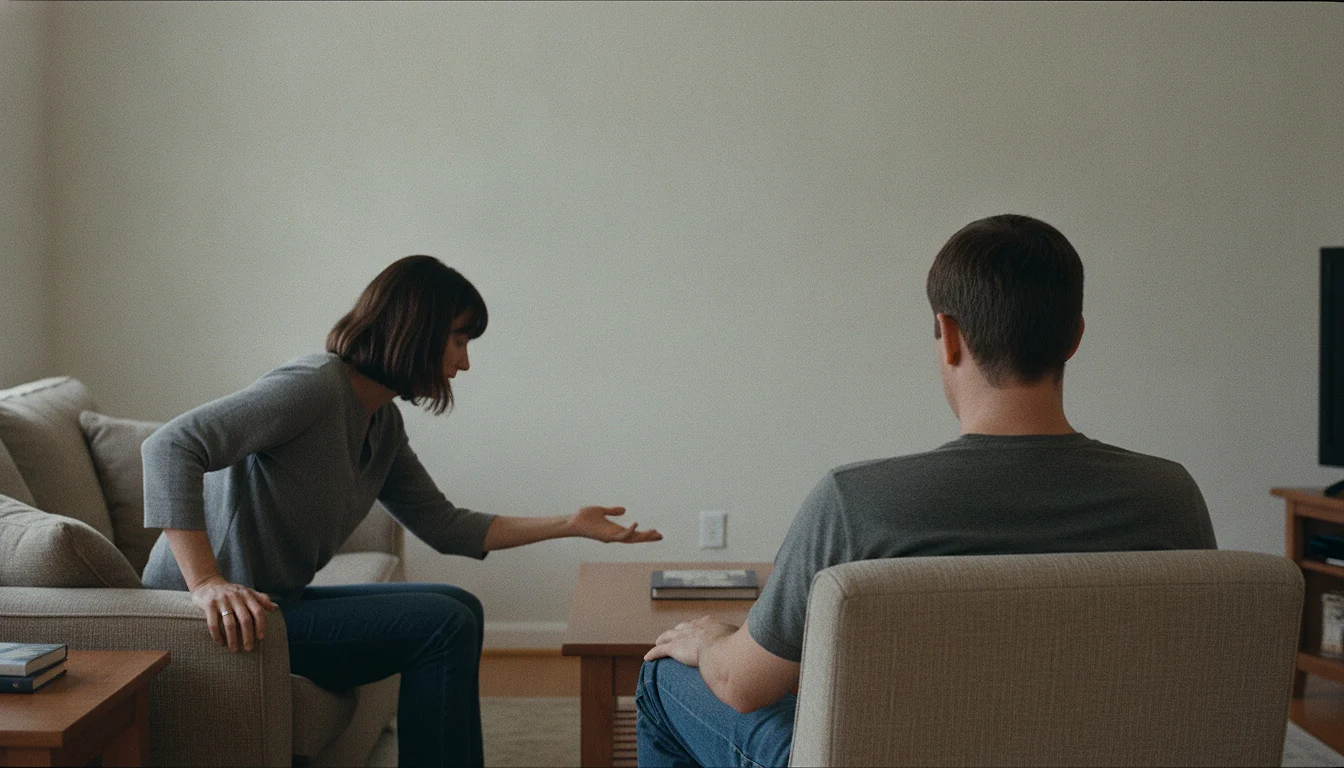
People come to the word stonewalling in the middle of something. An argument that ended with a closed door. A partner who answers “fine” to everything and nothing else. A silence that has lasted long enough to feel like an answer in itself.
Stonewalling is shutting down mid-conflict — going silent, giving one-word answers, turning away, or leaving the room — so the conversation hits a wall while the other person is still talking. This page is the plain-language version: what stonewalling means, what it looks like from both sides, why it happens, and how it behaves once it settles into a long relationship. The pages underneath it take the harder questions — what to do in the moment, what the pattern does to people over time, where the line into something more serious sits — and each is linked below.
One frame runs through the whole site. Stonewalling is the fourth of the Four Horsemen, a set of conflict patterns described by researcher John Gottman, whose team spent years watching real couples argue. We are an independent editorial guide to that framework — we describe it and point to the primary sources on our sources page; we have no connection to the researchers or their organisations.
What does stonewalling mean in a relationship?
Stonewalling means responding to a live conversation the way a wall would: no words, no expression, no sign the message landed. The listener withdraws from the interaction while still physically present — or removes themselves altogether — and the speaker is left mid-conflict with nobody on the other end.
The image inside the word does most of the work. A stone wall does not argue back, does not concede, and does not care how long you stand in front of it. The term has a long history in politics and legal proceedings, where it describes deliberate obstruction — refusing to answer, delaying, giving nothing away. Relationship writing borrowed the word, and Gottman’s research made it a fixture by naming it one of the four patterns his team kept seeing in couples whose relationships later came apart, the work reported in Gottman and Levenson’s 1992 study of marital dissolution.
That borrowed history matters, because it smuggles in an assumption: that the wall is a tactic. In couples, the research reads it differently. Stonewalling tends to start as overwhelm — a nervous system that has hit its limit and shut the gates — which is a different thing from a calculated refusal to engage, even though it looks identical from the outside. That difference runs through this whole guide, and it is the entire subject of whether stonewalling counts as mistreatment.
The word has also drifted. Consider social media, where “stonewalling” gets applied to a slow text reply, an unanswered email, or any silence that hurts. Used that broadly, it stops describing anything. This site keeps the narrower meaning from the research: a shutdown during live conflict, where one partner is still trying to talk and the other has stopped transmitting. A person who needs some time before discussing something hard is not stonewalling you. A person who goes blank mid-argument, every argument, is closer to the pattern.
One more clarification, because the grammar confuses people. “Being stonewalled” means being on the receiving end — you are talking to the wall. “Stonewalling” is the behaviour itself. We avoid “a stonewaller” as an identity where we can: the research describes something people do under specific pressure, not something people are.
How do you tell if someone is stonewalling you?
Stonewalling looks like engagement all but disappearing while the conflict is still live: silence or one-word answers, flattened expression, eye contact withdrawn, attention pointedly moved to a phone or a task, or an exit from the room with no word about returning. The conversation does not end — it hits a wall.
In practice it is a cluster of small behaviours rather than one dramatic move. The ones people describe again and again, on both sides of the wall:
- The answers shrink. Full sentences become “fine”, “sure”, “whatever”, “I don’t know” — words chosen to end the exchange, not to carry meaning.
- The face closes. Expression flattens into what observers of Gottman’s work often call the away look: eyes down or aside, jaw set, a face doing its best to signal not receiving.
- The body turns. Away from the speaker, toward a screen, into another task. Sometimes out of the room entirely, mid-sentence, without a stated plan to come back.
- Nothing comes back. No nod, no “mm”, no sign the words landed. Speakers describe the eerie feeling of hearing their own voice get louder to compensate.
- The topic dies. Not resolved, not conceded — abandoned. It will return, because nothing was done with it.
Two things are worth separating from this list. Silence alone is not stonewalling: people pause, think, and gather themselves in hard conversations, and a requested break with a stated return is the opposite of a wall — it is the documented counter-move. And a single shutdown after an awful day is not a pattern. What defines stonewalling is the combination: live conflict, withdrawal instead of engagement, and repetition across arguments.
The inside of the wall is another story. People who shut down describe it as static, a blank mind, a heart going too hard to think over, and a single overwhelming instruction: make this stop. Which is where the next section starts.
Why do people stonewall?
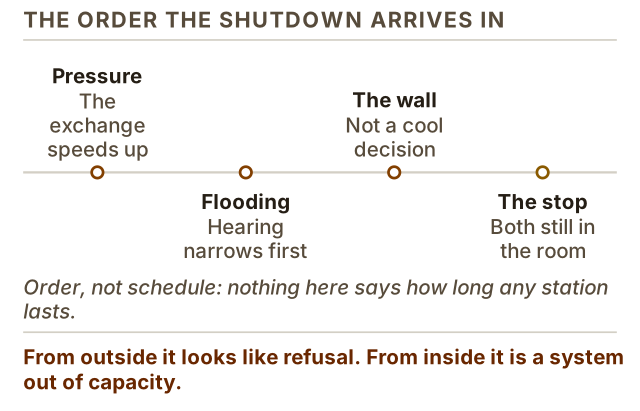
People stonewall because they are overwhelmed, not because they are indifferent. Flooding is the state of physiological overwhelm during conflict in which the body’s alarm system takes over and the capacity to listen, reason, and respond collapses; in Gottman’s account, shutting down is what that state looks like from the outside. In this account the wall is not built to punish; it is what remains when the ability to engage has gone.
Gottman’s research — the published work we list on our sources page, including Levenson and Gottman on physiological arousal during conflict — put instruments on arguing couples and found that partners who stonewalled were not calm behind the blank face — the opposite. Internally they were highly aroused, and the shutdown tracked that arousal. The flat expression is not the absence of feeling. It is the lid on too much of it.
The sequence tends to run the same way each time:
| Stage | What happens inside | What the partner sees |
|---|---|---|
| Pressure rises | The topic lands as threat: criticism heard or feared, stakes climbing, no visible way to a good outcome. | A normal argument. Often not even a loud one. |
| Flooding | The alarm system takes over — racing heart, blank mind, tunnel focus on escape. Listening capacity collapses. | Answers start shortening. Eyes drop. Something is going out of the room before the person does. |
| Shutdown | Engagement is cut to stop the internal overload. It feels like survival, not choice. | One-word replies, flat face, turned body — or an exit. |
| The wall | Relief mixed with dread: the conflict paused but nothing resolved, and the next round is now guaranteed. | A partner who was mid-sentence, alone with an unfinished argument. |
Why some people flood faster than others has several honest answers. Histories where conflict meant danger, or where speaking up never changed anything, train a nervous system to treat raised voices as emergencies. Some people simply run hotter physiologically under stress. And some learned, over years of the same argument, that engaging prolongs it and silence ends it — a lesson that rewards the wall every time it is used.
The gender question arrives in its own phrasing: why do men stonewall. Gottman’s research describes men as the more frequent stonewallers in the heterosexual couples his team studied, and ties this to physiology — arousal during conflict spiking quickly and settling slowly — rather than to indifference. Treat that as a described tendency, not a rule: women stonewall, men pursue, and the pattern matters more than the demographics.
None of this makes stonewalling harmless. Overwhelm explains the wall; it does not resolve the argument, comfort the person left mid-sentence, or answer for what repeated shutdowns do to both partners over time. Explanation and effect are different questions, and this guide keeps them on separate pages.
This page describes a shutdown from the outside and from the inside, and it stops there. It does not establish that a particular silence in a particular house is overwhelm rather than something aimed, it does not assess anyone’s partner, and it makes no claim about how any relationship ends. Where the silence has started to feel like control rather than collapse, that is a conversation for a professional, not a page.
What does stonewalling do to a marriage over time?
In a long relationship, stonewalling stops being an event and becomes an architecture. Each shutdown teaches both people something: one learns that certain topics end in a wall, the other learns that walls end arguments. Over years, the couple quietly builds a map of subjects they no longer attempt — and the marriage gets smaller to fit it.
Left to run, the pattern hardens into roles. One partner pursues: raises the issue, follows into the next room, repeats the question with rising volume, because being answered by silence is genuinely hard to bear. The other withdraws: floods faster with each round, shuts down earlier, eventually pre-empts the argument by going quiet at the first sign of the topic. Each side’s move makes the other’s more likely. Couples describe running this loop for years without either person wanting it.
What accumulates is not dramatic. It is unfinished conversations, decisions made by default because discussing them was impossible, and two people who still function — schedules, children, logistics — while the list of unsayable things grows. For example, partners on the receiving end often say the loneliness inside the marriage is worse than any argument was. Partners who shut down often say they had no idea the silence read as rejection; from the inside it felt like preventing something worse.
Two things are true at once here, and this site will not pick one for you. A marriage can carry this pattern for a long time and still turn, because stonewalling has a documented counter-move — structured breaks with a real return, covered in how to respond and how to stop shutting down. And a wall that never opens, or one used deliberately to control what a partner may raise, is a different situation from overwhelm — the difference is laid out in where the line sits.
The other three horsemen
Stonewalling arrives with company. In the framework it belongs to — the Four Horsemen, described by researcher John Gottman — it is described as the last pattern to appear, after the other three have made conversations feel unwinnable. Knowing the other horsemen explains a lot about why the wall goes up, and the full framework overview walks through all of them together.
Criticism recasts a complaint as a defect in the partner’s character — “you always”, “you never”, “what is wrong with you” — so the topic stops being the dishes and starts being the person. It is the classic opening move, and for many couples the argument that ends in a shutdown began with it. The criticism page covers the difference between a complaint and a verdict.
Contempt goes further: mockery, sneering, hostile humour, treating the partner as beneath you. Gottman’s research singles it out as the most corrosive of the four. On this site it gets a deliberate overview only — enough to place it in the framework.
Defensiveness is meeting a complaint as if it were an attack: excuses, counter-charges, the innocent-victim stance. It matters here because it feeds the loop that ends at the wall — complaint, defence, escalation, flood. The defensiveness page shows what it sounds like in real exchanges.
The four are patterns, not a diagnosis and not a countdown. Gottman’s team described them because they were observable and because each has a documented counter-move — which is why naming the pattern in your own arguments is worth more than any quiz about whether your relationship is doomed.
What this page does not do
A guide to a conflict pattern earns trust by being clear about its limits. Ours:
- We do not diagnose your relationship
- This page describes a behaviour pattern from published research. It cannot tell you what your partner feels, why they specifically go quiet, or what your silence at home means. Recognising a pattern is not a verdict on a person or a marriage.
- We do not equate silence with mistreatment
- Stonewalling, as the research reads it, comes from overwhelm — and some silence is something else. That distinction deserves care, not a headline — it has its own page, written as information about boundaries, with a clear note on where an information page stops and professional help begins.
- We do not quote the folklore statistics
- This topic travels with famous-sounding percentages and ratios. None of them appear here, because we have not yet verified them against primary sources. What we have read and how we read it is on the sources page.
- We do not sell a method
- We describe the Four Horsemen framework with attribution to the researchers who built it. We are not affiliated with them, we are not therapists, and nothing here is a treatment plan.
The parts of this guide
Each page below takes one question this overview deliberately left open, in one extractable sentence each:
- Is stonewalling abuse? — the difference between a shutdown that comes from overwhelm and silence used deliberately to punish or control, read through pattern and function rather than a single incident.
- How to respond to stonewalling — why pushing harder deepens the shutdown, how a structured break with an agreed return actually works, and how stonewalling differs from the silent treatment.
- The emotional effects of stonewalling — what repeated shutdowns do to the partner left outside the wall, to the person behind it, and to the pool of things a couple can still talk about.
- How to stop stonewalling — for the one who goes quiet: catching flooding before the wall goes up, taking breaks that genuinely end, and coming back to the conversation.
For the framework the wall belongs to, start with the Four Horsemen overview. For what we have read and why no statistic appears on this site yet, see our sources.