
Contempt is treating a partner as beneath you — sneering, mockery, eye-rolling, hostile humour — and it is the second of the four horsemen, the one researcher John Gottman’s work treats with the most alarm. Where the other patterns in the framework describe ways an argument goes wrong, contempt describes something quieter and worse: one partner speaking to the other from above, as if to someone lesser. This page stays deliberately at overview altitude — what the pattern looks like, how it differs from criticism, why researchers single it out, and which direction the counter-move points. The full framework, and where contempt sits inside it, is laid out in the four horsemen overview.
What does contempt look like in a relationship?
Contempt looks like scorn aimed at a partner: the sneer, the eye-roll, mimicry of their voice, mockery dressed as humour, and corrections delivered with an audience. Contempt does not need words to announce itself. It travels in the channel around them: the sneer, the eye-roll aimed at the partner, the theatrical sigh, the mimicry of a partner’s voice, the laugh that arrives at the partner’s expense rather than at a shared joke. When it does use words, they tend toward mockery and hostile humour — “oh, brilliant plan”, “did you figure that out all by yourself?” — sentences whose literal content is almost irrelevant, because the message is carried entirely by the altitude they are delivered from.
For example, a few ordinary scenes make the pattern audible. One partner describes a hard day at work; the other says “must be exhausting, sitting in meetings”, with a smile that is not warm. One partner suggests a way to handle a family visit; the other repeats the suggestion back in a sing-song voice before answering it. One partner gets a detail wrong at dinner with friends; the other corrects it with a glance around the table, recruiting an audience. In each scene there may be a real disagreement underneath — about workload, about in-laws, about accuracy. But the disagreement is not what is being expressed. What is being expressed is a ranking.
That is the signature to hold onto. Every variety of contempt — sarcasm, scorn, mockery, name-calling, the cold correction, the eye-roll — performs the same underlying move: it positions the speaker above the partner and invites the partner to notice the height difference. The topic of the argument is a vehicle; the cargo is disdain.
It is worth saying plainly that a single sarcastic sentence in a long marriage is not a pattern. Ordinary couples produce moments they wince at later. The horseman is the habit — scorn as a recurring register, mockery as a default seasoning — not the isolated lapse.
How is contempt different from criticism?
No — the difference is altitude. Criticism is the first horseman: it converts a complaint about an event into a verdict about a person, so that “you forgot to call” becomes “you never think about anyone but yourself”. That is already a damaging move, and it has its own page. But criticism, for all its unfairness, is still delivered between equals. The critic is angry at a peer. The sentence expects — even demands — an answer.
Contempt changes the geometry. Consider the same grievance delivered with contempt: it arrives from above: “you forgot to call — of course you did. Expecting you to remember anything was my mistake.” The complaint is still in there somewhere, and so is the character verdict. What has been added is superiority — the speaker’s settled position that the partner is a lesser kind of person, and that this has been established for some time. The framework’s shorthand is simple enough to draw:
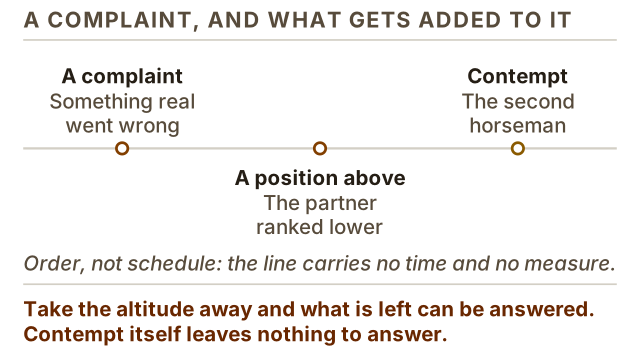
The practical consequence of the added altitude is what makes contempt harder to answer than criticism. A criticism, however unfair, can be met: contested, partially conceded, converted back into the complaint hiding inside it. Contempt forecloses those exits, because it does not ask the partner to change anything. It informs the partner of what they are, from a height where their reply does not carry. There is no action available tonight that refutes a sneer.
The two horsemen also feed each other in a particular direction. Criticism that goes unanswered for long enough tends to harden — the verdicts stop being angry conclusions reached mid-argument and become settled beliefs held between arguments. When a partner starts arriving at the conversation already holding the verdict, the tone that carries it is contempt. That drift, from heated overstatement to cold ranking, is the border between the first horseman and the second, and it is worth watching for precisely because it is gradual.
Why do researchers treat contempt as the most serious horseman?
Summaries of Gottman’s work — including the Gottman Institute’s own description of the four horsemen — make the same point about contempt: of the four horsemen, it is described as the most corrosive, and its presence in a couple’s arguments worried the researchers more than any other single pattern they coded. The research reached that view by observation — recording couples in real disagreements, coding the exchanges, and following what became of the relationships, the approach reported in Gottman and Levenson’s 1992 study of marital dissolution — and contempt kept standing out in the couples whose relationships later ended.
The qualitative explanation the research offers is about what contempt communicates. The other horsemen are, at bottom, distorted forms of engagement: criticism engages the partner’s character instead of the problem, defensiveness engages the accusation instead of the complaint, stonewalling is engagement collapsing under flood. Contempt is different in kind. It communicates disgust — that the partner is not merely wrong on this occasion but beneath consideration in general. A partner can fight about who is right. It is much harder to stay in a conversation, or a relationship, whose recurring message is you are lesser.
Gottman’s writing also describes contempt as the horseman that most reliably poisons what he calls the couple’s friendship — the ordinary fondness and mutual respect that arguments draw on for repair. The other patterns damage individual conversations; contempt drains the account that every conversation is paid from. That is the sense in which researchers treat it as the most serious of the four, and the reason its antidote works on the account rather than on any single argument. The first-source material behind these descriptions is listed on our sources page.
Contempt is the framework’s heaviest word, and this page uses it about sentences, not about people. Naming the move in an argument says what the argument did. It does not say what either partner is, and nothing here can tell a reader whether scorn in their own home is a habit two people can unwind or part of something heavier. That question belongs with someone who can hear the whole of it.
Can contempt be repaired?
In Gottman’s framework, yes: contempt is a behaviour with a described counter-move, not a permanent state. The antidote to contempt is not a sentence to say in the argument. It is a culture to build outside of it — described in Gottman’s published work, which we list on our sources page — a deliberate practice of noticing what the partner does well and saying so — appreciation made routine rather than reserved for anniversaries. The logic follows from the diagram above. Contempt is a ranking that hardens between arguments, so the work that counters it also happens between arguments, in the slow accumulation of expressed respect that makes the ranking harder to hold.
This page keeps to the direction rather than the program, but the direction itself is worth stating precisely. Appreciation, in this framework, is not flattery and not a truce offering mid-fight. It is attention: catching the partner doing something right, and saying it out loud, on an ordinary day, when nothing is being negotiated. Scorn grows in the gap between what a partner contributes and what gets acknowledged; the practice narrows the gap.
In practice, mid-argument the nearest tool is different — the small de-escalations that interrupt an exchange already going wrong, from a softened tone to “can we start over”. Those have their own page: repair attempts — the family of small mid-argument moves, and what it takes to notice one aimed at you. Repair attempts will not dissolve a settled habit of contempt on their own, and it would be dishonest to suggest they can. They keep individual conversations recoverable while the slower work of appreciation does its part.
What this page deliberately is not
A full treatment of contempt — how the habit forms, how couples work their way out of it, what it does to the person on the receiving end over years — is a book-length subject, and a deep guide to it is not this site’s genre. This site describes the four-horsemen framework as a whole, and this page holds contempt’s place in it: the second horseman, the one research worries about most, defined by superiority and answered by appreciation.
What this page does not claim
Contempt is the framework's heaviest word, which makes it the easiest to misuse. The boundaries below are deliberate.
- That noticing contempt is a verdict on a person
- The framework names a behaviour — speaking from above — not a character type. Recognising the pattern in an argument tells you about the argument. It does not establish what either partner is, and this page will not use it that way.
- That one sarcastic exchange defines a relationship
- Ordinary couples produce moments of scorn they regret. The research pattern is a recurring register, not an isolated lapse, and no single recorded sentence — in a lab or a kitchen — settles anything on its own.
- That an overview can weigh your situation
- Whether contempt in a particular relationship is a habit two people can unwind, or part of something heavier, is not a call an overview can make from a distance. Where that question is live, it belongs with a professional, not a website.
- That this page is the deep guide
- It is intentionally the short one. It covers contempt as one of the four horsemen and stops there; readers who need more than the framework's outline deserve a fuller treatment than an overview can honestly give.
What it does stand behind
- The complaint-plus-superiority definition
- The diagram above is the pattern's load-bearing idea, stated with attribution to the research it comes from: contempt is a grievance delivered with altitude, and the altitude is what makes it unanswerable.
- The distinction from criticism
- Verdict between equals versus verdict from above. The border matters because the two horsemen call for different responses, and because the drift from one to the other is gradual enough to miss.
- The direction of the antidote
- A culture of appreciation, built between arguments — described as a direction, honestly, without pretending an overview page can carry anyone through the practice.