
Criticism in relationships is a complaint reframed as a defect in your partner’s character — not the everyday kind of criticism, where one person tells another that something is not working, but the kind that turns a specific problem into a statement about who the partner is. It is the first of the Four Horsemen, a framework described by researcher John Gottman for the conversation patterns his team observed in couples whose relationships later ended — the work reported in Gottman and Levenson’s 1992 study of marital dissolution; the published material behind it is listed on our sources page. Of the four, Gottman’s account describes criticism as the one that opens the door for the others, which is why the distinction at the centre of this page matters more than it first appears to.
What is the difference between criticism and a complaint?
A complaint is about an event; criticism is about a person. “You said you’d call and you didn’t, and I was worried” reports a specific thing that happened and what it cost. “You never think about anyone but yourself” takes the same event and converts it into a character verdict. In Gottman’s framework, that conversion — from what happened to what you are — is the whole difference between an ordinary complaint and the first horseman.
The distinction is easy to state and hard to hold onto mid-argument, because criticism feels like a stronger version of the complaint. It is not. A complaint asks for something and can be answered: apologise, explain, do it differently next time. A character verdict cannot be answered, only contested. There is no action a partner can take tonight that disproves “you never think about anyone but yourself”.
| Complaint | Criticism | |
|---|---|---|
| Target | A specific event or behaviour | The partner's character |
| Grammar | "When X happened, I felt Y" | "You always…", "you never…", "why are you so…" |
| Scope | This situation | A pattern claimed about the whole person |
| What it asks for | A change that can actually be made | A defence — there is nothing to do, only to deny |
| Likely reply | An answer to the problem | A counter-attack or a wall |
Certain markers help in real time. The words always and never signal that the sentence has become a verdict, because no one is being asked to address an event any more — they are being asked to account for their nature. And the question “what is wrong with you?”, in any of its forms, is not a question. It is a diagnosis wearing punctuation.
What are some examples of criticism in a relationship?
Criticism in a relationship sounds like “you always leave everything to me”, “you never listen”, “why are you like this”, “you’re just like your father” — real grievances delivered as verdicts about a person rather than as requests about a situation. Criticism examples are easiest to hear in pairs: the complaint that was available, and the verdict that got said instead. For example, in each of the four scenes below the underlying grievance is legitimate. That is the point — criticism does not need an invented problem. It is a real problem delivered as an indictment.
The dishes. Available: “The kitchen was left for me again last night, and I’m tired of being the one who notices.” Said instead: “You always leave everything to me. You’d live in filth if I weren’t here.” The first names a division-of-labour problem. The second tells a person what they are, and invites them to defend the whole of themselves rather than wash anything.
The phone. Available: “You were on your phone through most of dinner, and I felt like I was eating alone.” Said instead: “You never listen to me. Talking to you is pointless.” The first can be answered by putting the phone down. The second has already announced that no answer will count.
The lateness. Available: “When you’re late and don’t text, I stop knowing whether to worry or be angry.” Said instead: “Why are you like this? Everyone else manages to be on time.” The comparison to everyone else is a verdict with witnesses — the partner is now defective in public, not late on a Tuesday.
The money. Available: “That purchase surprised me, and I’d like us to agree on limits.” Said instead: “You’re completely irresponsible with money, just like your father.” Reaching into family history converts a budgeting question into a statement about lineage, and there is no receipt that refunds that.
Read the pairs again and one thing stands out: the critical version is shorter and feels truer in the moment. Compressed grievance sounds like clarity. What it compresses out is the request — and without a request, the partner has nothing to respond to except the attack itself.
When this becomes the default opening rather than an occasional lapse, couples describe it as constant criticism, and at that point the content stops mattering. The partner on the receiving end stops hearing individual complaints — about dishes, phones, money — and starts hearing a single continuous message about their worth. Every new sentence beginning “you always” gets filed as another instance of it, unheard.
Why does criticism escalate?
Criticism escalates because a character verdict cannot be conceded. A partner can accept “you forgot to call” and repair it; there is no comparable way to accept “you are selfish” and go make dinner. So the natural reply to criticism is a defence of the self — which, in the framework, is the next horseman: defensiveness, the counter-attack or the innocent-victim stance that arrives instead of an answer.
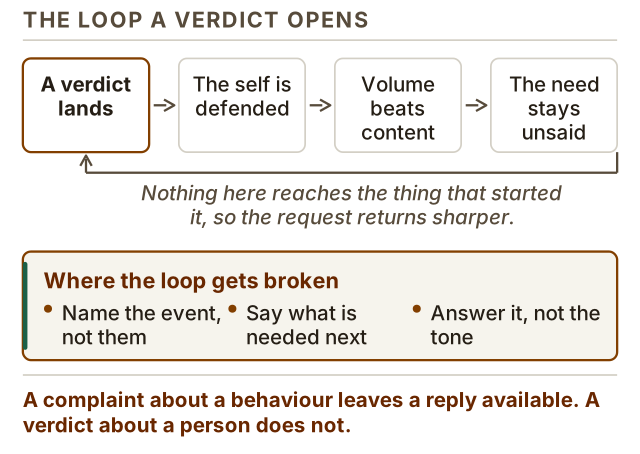
From there the chain runs on its own fuel. The criticising partner hears the defence as proof that nothing lands, and presses harder; the defending partner hears the pressing as proof that this is about their worth, and defends harder. Repeated over months, the chain tends to recruit the other horsemen — verdicts curdle toward contempt, and the partner who keeps losing these exchanges may eventually stop entering them at all. Where each of the other patterns sits in the framework is laid out in the four horsemen overview.
None of this requires anyone to be cruel. The chain runs perfectly well between two people who love each other and are each, from the inside, only responding to what the other just did.
How do you stop criticizing your partner?
You catch the sentence before the character verdict lands and replace it with a request. The gentle start-up is the counter-move Gottman’s research pairs with criticism, and the practice written up for couples in The Seven Principles for Making Marriage Work: open the conversation with the situation, the feeling, and the need — not with the partner’s character. The shape is plain: describe what happened in neutral terms, say what you feel using “I” rather than “you”, and ask for the specific thing that would help. The complaint survives intact; only the verdict is removed.
In practice: “When the plans got cancelled without a message, I felt like an afterthought. I’d like a text when things change.” Every part of the grievance is still there — the event, the hurt, the standard being asked for. What is missing is the sentence about what kind of person does this, and that missing sentence is the reason the reply can be an answer instead of a defence.
Honesty requires saying that the gentle start-up feels worse to deliver. A verdict discharges the anger; a request exposes the need under it. “You never prioritise me” is armour. “I felt like an afterthought” is a door left open, and doors can be walked through or ignored. The practice asks the angrier partner to take a small risk first, and there is no version of it that does not.
It also fails sometimes, and it is worth being plain about how. A gentle start-up delivered in a cold voice is a verdict in costume, and partners hear the voice, not the grammar. And a request made softly is still a request that can be declined — the start-up changes what kind of conversation is possible, not what your partner decides inside it. Descriptions of the practice and the research behind it are in the first-source material listed on our sources page.
If you are the one being criticised
Being on the receiving end of constant criticism narrows into a bleak choice: absorb the verdicts or contest them. There is a third option, which is to answer the complaint you can find inside the criticism and decline the verdict wrapped around it. Consider “you always leave everything to me”: it tends to carry “I need help tonight” inside it — and it is possible to respond to the second sentence without signing the first.
That move is easier to describe than to make while stung, and it is not a duty. Nobody is obliged to do archaeology on every attack to find the need buried in it. But when there is enough goodwill left to try, answering the complaint tends to interrupt the chain in the diagram above at its second link — the defence simply never arrives, and the escalation has nothing to climb.
The other half of the option is naming the pattern outside the argument, at a calm moment: what lands as a verdict, what would land as a request. Mid-conflict, that conversation is impossible; between conflicts, it is just difficult. The small mid-argument moves that de-escalate an exchange already underway — the joke, the touch, the “can we start over” — have their own page: repair attempts, which covers both making them and noticing the ones aimed at you.
If the criticism in your relationship runs mostly one way, has stopped containing findable complaints, and continues unchanged after being named calmly, that is a heavier situation than a communication pattern, and a page about conversation habits is the wrong tool for it. That distinction — pattern versus something else — is a question for a professional, not for a website.
What this page does not claim
Criticism is a describable pattern with a documented counter-move. The common misuses of the idea come from stretching it further than that.
- That noticing the pattern is a diagnosis
- Recognising criticism in your arguments tells you about the arguments, not about either person's character or the relationship's fate. The framework names behaviour; it does not assess people.
- That the gentle start-up guarantees an outcome
- It changes what kind of reply is possible. It does not control what your partner does with that possibility, and we do not publish techniques that claim to.
- That all negative feedback is a horseman
- Complaints, disagreement, and hard conversations are part of working relationships. The pattern is specifically the conversion of a complaint into a character verdict.
- That this page can weigh your relationship
- Whether a pattern of verdicts is a habit two people can unlearn or a sign of something heavier is a judgement no article can make from outside. Where that question is live, it belongs with a professional.
What it does stand behind
- The complaint–criticism distinction
- One sentence targets an event, the other targets a person, and the difference shapes which kind of reply comes back.
- The escalation chain
- Verdicts produce defences, and defences feed verdicts. Seeing the chain mid-argument is what makes stepping out of it possible.
- The gentle start-up, honestly described
- Situation, feeling, request — with attribution to the research it comes from, and with its costs and failure modes stated plainly.