Gottman love maps questions are the practical end of an idea that sounds almost too simple to matter: you fight better with someone whose inner world you actually know. A love map, in the framework described by researchers John and Julie Gottman, is the mental file you keep on your partner — what is stressing them this month, which friendship just frayed, what they are quietly hoping for, how they take their coffee when no one asks. The questions are how that file gets updated on purpose instead of by accident. This page explains the idea with proper attribution, points to the official materials without copying them, and offers our own open-ended prompts you can use tonight.
What is a love map?
A love map is the mental file you keep of your partner’s current inner world — their stresses, hopes, friendships, and small preferences — updated on purpose rather than by accident. The metaphor is a map because the territory moves. The person you married, or moved in with, or matched with, keeps changing — new pressures, new people, new small preferences — and the map in your head either gets redrawn or goes quietly out of date. In the Gottmans’ account, couples who stay close keep a richly detailed, current map of each other’s worlds; couples who drift keep navigating by an old one, confidently wrong about where things now are.
What goes on the map is deliberately ordinary. Not a partner’s deepest philosophy, but the texture of their current life: the name of the colleague who makes their days harder, the worry they mentioned once and dropped, the thing they are looking forward to, the food they have gone off. None of these items matters much alone. Together they are the difference between being known and being remembered.
Some honest notes on attribution. The term, the exercise, and the research behind it belong to John and Julie Gottman and the body of work around their studies of couples; this site is an independent editorial guide with no connection to them or their organisation. And the concept comes from observing couples who lasted — it is a description of what closeness looks like, turned into a practice, not a discovery that quizzes create love.
Why do love maps belong on a four-horsemen site?
This site is about the four horsemen — the conversation patterns Gottman’s team observed in couples whose relationships later ended, the work reported in Gottman and Levenson’s 1992 study of marital dissolution. A love map looks out of place next to them: it is not a pattern in an argument at all. It is here because it works on the soil the horsemen grow in, and that makes it the closest thing the framework has to prevention.
The mechanism is unglamorous. Criticism — the first horseman — thrives on misreading: a partner’s shortness gets read as disrespect, their forgetfulness as not caring, and the complaint arrives pre-hardened into a character verdict. An updated map changes the reading before the sentence forms. For example, if you know your partner’s week has been swallowed by a deadline, the unwashed dishes have a context; “you never do anything here” becomes harder to say sincerely, because you can see the actual reason from where you stand.
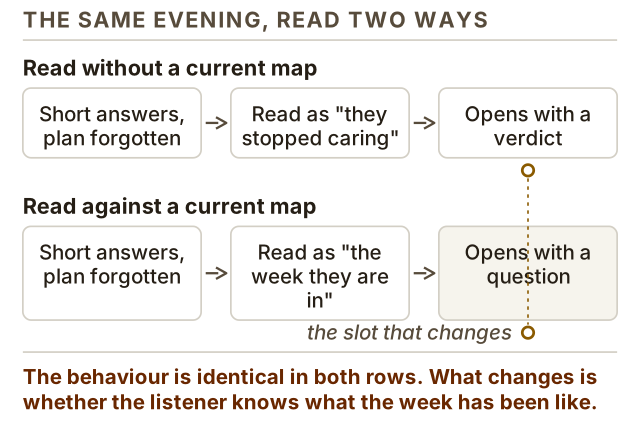
The buffer works in the other direction too. Being accurately known is disarming. A partner who feels seen — whose stresses were asked about before they became explanations shouted mid-argument — comes into conflict with less to prove, which starves defensiveness of its fuel. And when an argument does happen, shared knowledge is what repair attempts are made of: the inside joke that breaks tension only works if the joke is still current.
Stated qualitatively, because that is all we can honestly state: in the Gottmans’ research, detailed knowledge of each other’s worlds is one of the things that distinguishes couples who weather conflict from couples the horsemen take over. We publish no figures for how much it helps, because we have not verified any — our reasoning about numbers is on the sources page.
What questions does Gottman use to build a love map?
In his published work, John Gottman uses factual questions about your partner’s current life — who their closest friend is right now, what is stressing them, what they would do with a free afternoon — questions with checkable answers that test how up to date your knowledge is. The Gottmans turned the idea into concrete materials: a love-map exercise appears in John Gottman’s published books for couples — of which The Seven Principles for Making Marriage Work is the best known — as a quiz of factual questions about your partner’s current life, and the Gottman brand also sells a card deck of love-map questions, along with an app version. The format is consistent across all of them — questions with checkable answers. Who is your partner’s closest friend right now? What is currently stressing them? What would they do with a free afternoon? You are not asked to interpret your partner, only to demonstrate that your file on them is up to date.
We do not reprint those questions here. They are the Gottmans’ copyrighted work, and an independent guide that respects the research should send you to the first source rather than launder it: the books and official card decks are easy to find from the publishers and the rights holders, and our sources page lists the first-source material this site is built on.
What we can add is a reader’s note on format. The official exercise is a knowledge test, and knowledge tests have a failure mode in tense couples: a wrong answer lands as evidence in an ongoing case. If the state of your relationship is such that “you don’t even know my friend’s name” would detonate rather than amuse, start with open-ended questions — like the ones below — where there are no wrong answers to score, only answers you haven’t heard yet.
What love map questions can you ask tonight?
Ask open-ended questions about your partner’s current world, the people in it, what they are hoping for and dreading, and the small preferences you may still get wrong. These prompts are our own text, not the Gottmans’ — written to the same purpose but in a different format. They are deliberately open-ended: not “what is my sister’s name” but questions that hand your partner the pen and let them redraw their own region of the map. Drop a question into dinner conversation and see where it goes; do not run the list like an intake interview.
The current world. What is taking up the most room in your head this week? Which part of your day do you brace for, and which part do you look forward to? Who at work or in your family is costing you energy right now — and who is giving you some back? What have I been underestimating about your last month?
People. Which friendship feels closest at the moment, and which one has drifted? Is there anyone you miss that I wouldn’t guess? Whose opinion of you matters more than you let on?
Hopes and dreads. What are you quietly looking forward to? Is there a decision you keep postponing? If the next year went unusually well, what would be different — and what are you half-expecting to go wrong instead?
The small print. What is a preference of yours I still get wrong? What do you wish we did more of that costs nothing? What has changed about you recently that you haven’t said out loud yet?
The map itself. Where do you feel most misread by me these days? What question do you wish I asked more often?
There is a habit that turns the list from a quiz into a map: follow the answer, not the list. In practice, if “which friendship has drifted” opens something, the next question comes from what they said, not from this page. The prompts are ignition, not the engine.
How do you ask love map questions so they land?
A good question asked badly is an interrogation. The difference is in the habits below, none of which requires a script.
Ask to learn, not to confirm. The map-corrupting move is asking a question you believe you know the answer to, then arguing with the reply. Consider a familiar exchange: “Which part of your day do you brace for?” — “Actually, the mornings.” — “No you don’t, you love mornings” redraws nothing; it laminates the old map. The answer that surprises you is the exercise working, not failing.
Receive before you relate. The reflex on hearing a partner’s stress is to produce your matching stress, your advice, or your defence if you appear in the story. Each of these ends the answer early. The move that keeps the pen in their hand is smaller: ask the next question about what they just said. Relating can come after the map is drawn.
Do not weaponise the returns. The fastest way to close this channel for good is to quote it in an argument — “you said yourself your job is what’s stressing you, so don’t take it out on me.” Map knowledge used as ammunition teaches a partner to stop filling in the map. What they tell you in answer to these questions has to be safe ground, or it will be the last honest answer you get.
And a boundary worth stating plainly: these are questions to offer, not to require. A partner who does not want to answer tonight is giving you map data too — something about timing, energy, or trust — and pressing turns a closeness exercise into a compliance exercise. If conversations in your relationship reliably cannot get this far because they collapse into verdicts or shutdowns first, the horsemen pages on this site are the earlier stop, starting with how criticism opens the spiral.
What this page does not claim
A love map is a modest tool with a specific job. Misuse of it comes from asking it to do more than that.
- That questions alone rescue a relationship
- Love maps are prevention and maintenance. Where contempt, entrenched criticism, or chronic shutdown are already running, a question deck is not the intervention — and we do not publish tools that claim otherwise.
- That we speak for the Gottmans
- The term, the research, and the official exercises belong to John and Julie Gottman. This is an independent editorial guide, not affiliated with, certified by, or endorsed by them or their organisation.
- That knowing your partner guarantees peace
- An updated map changes how conflicts open and how behaviour gets read. It does not settle real disagreements about money, family, or the future — those still have to be had.
- That this page can assess your relationship
- If answering or asking these questions feels unsafe rather than merely awkward, that is a signal beyond this page's scope, and a conversation for a professional rather than a website.
What it does stand behind
- The idea, honestly attributed
- Detailed, current knowledge of each other's worlds is one of the things Gottman's research describes in couples who last — stated qualitatively, with the first sources listed on our sources page.
- The prevention link
- A current map softens how conversations start and how behaviour is read, which is exactly the ground the first horseman needs to grow.
- Our own prompts
- The questions on this page are our text, written to be open-ended and score-free — usable tonight, and safe to fail at.