About this site
An anonymous guide to four patterns of arguing
No bylines, no invented authors, no figures. What is here instead: a described framework, its counter-moves, and a clear statement of where the description stops.
Who writes here
Four Horsemen Guide is written and maintained as an anonymous editorial project. There are no bylines, no photographs of authors, and no borrowed credentials — not because the people behind it are hiding, but because a made-up therapist with a made-up practice is the cheapest trick available on a subject like this one, and it is the one thing a reader has no way to check.
What is checkable is the page itself: whether it names the framework it is describing, whether it says which parts are description and which are opinion, whether it declines to publish a figure it cannot trace, and whether it stops where its evidence stops. So those are the things this site commits to, and they are listed below in enough detail to be held against it.
How a page here is made
Six rules, each of which is enforced by something other than good intentions — a build gate, a visible label, or a field in the page’s own data.
The framework is described, not extended
Every page here sets out something that already exists in the published work on the four horsemen and stops at its edge. Where this guide has an opinion — about how a sentence sounds in a real kitchen, about which counter-move is easiest to start with — it is written as an opinion, in the first person plural, and not smuggled in as a finding.
No figures at all, on purpose
This site publishes no percentages, no accuracy rates, no counts of couples. The build has a fact gate that refuses any number not traceable to a named publisher, a year and a URL that was actually opened; the list it checks against is deliberately empty, so the gate blocks every figure. The best-known numbers attached to this framework are blocked by it too. A guide that repeats a figure it has not verified is worth less than one that declines to.
The pictures say what they are
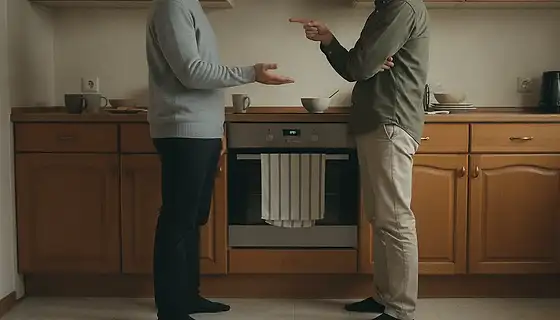
Photographs here are generated, and every one of them carries a visible label saying so, next to a caption that says why the picture is on the page. Diagrams are drawn from the article they sit in and labelled as diagrams, because a diagram depicts nothing — it shows a structure. Nothing on the site is presented as documentary evidence of anything.
Sentences, never people
The four horsemen describe how an argument is conducted. They do not describe who is conducting it, and no page here will tell a reader what is true of their partner or predict how a relationship ends. Where a question needs someone who can hear the whole of a situation, the page says so and stops.
Written with AI, edited by a person
Drafting is AI-assisted and every page is read and revised by a human before it is published. That is stated here rather than hidden, because the alternative — an invented author with invented credentials — would be the single most misleading thing this site could do.
Dates mean two different things
Each page carries the day it was published, the day it was last checked against its sources, and, if they differ, the day it was last edited. A layout fix moves the edit date; only re-reading the page against what it cites moves the checked date. Keeping them apart is the only way either is worth printing.
What this guide claims, and what it does not
What it claims
- That four recurring moves inside an argument have names, and that naming them makes them easier to interrupt.
- That each of the four has a counter-move described alongside it in the same body of work.
- That the subject is the conduct of a conversation — something two people can practise changing.
What it does not
- That reading a page here establishes anything about a reader or a reader’s partner.
- That the presence of a pattern forecasts an outcome. Nothing here predicts how a relationship ends.
- That an independent guide has any affiliation with the researchers whose framework it describes.
What is covered
- The four horsemen
- Criticism, contempt, defensiveness and shutting down — one overview page each, written to be read in either order.
- Stonewalling in depth
- The one pattern with its own set of pages: what it does to both partners, how to answer it, how to catch it early, and where the word stops being accurate.
- The counter-moves
- Repair attempts, the exits built into an argument; and love maps, the knowledge of each other that decides how an argument opens.
- Questions
- Short answers to the things people ask before they know which page they want, each linked to the page that carries the long version.
The complete list, with the date each page was last checked, is on the index of all articles. Where the framework itself comes from is set out on the sources page, and the rules above are written up at greater length in the editorial policy.
Where people start
Three of the six sections, in the order most readers seem to want them. None of them assumes you have read any of the others.
- Stonewalling: Meaning, Signs, and Why It Happens
What stonewalling means in a relationship, how to recognise it, why research reads it as overwhelm, and where criticism, contempt and defensiveness fit in.
11 min readRead
- Criticism in Relationships: The First Horseman
How criticism differs from a complaint, what it sounds like in real arguments, and the gentle start-up that research pairs with it as the counter-move.
8 min readRead
- Defensiveness in Relationships: Examples and the Way Out
What defensiveness looks like in real arguments, why it reads as counter-attack, and the counter-move research suggests: owning your small part first.
9 min readRead


Corrections and contact
If a page here states something that is wrong, or describes the framework in a way its authors would not recognise, that is worth an email and it will be fixed with the date of the fix printed on the page. Write to hello@fourhorsemenguide.com or use the contact page.
One argument, drawn out flat
That did not go through. Nothing was saved and nothing was sent. Try the address again, or write to us directly and we will add you by hand.
- What arrives
- One exchange, written out the way it actually gets said, with the pattern named and the counter-move next to it.
- What does not
- No diagnosis of anyone’s partner, no predictions about how a relationship ends, and the address goes to no third party.