
The Four Horsemen are researcher John Gottman’s name for four conflict patterns: criticism, contempt, defensiveness, and stonewalling. Some questions about them do not belong to any one of our pages. They cut across the whole framework, or they arrive before a reader knows which page to look for. This page collects them.
Every answer below is written to stand on its own, in a few sentences, with a link to the page where the topic gets full treatment. If you already know which pattern you are dealing with, you may be better served going straight to the overview and following the links from there.
Where does the name “Four Horsemen” come from?
Researcher John Gottman borrowed the image of the four horsemen of the apocalypse — an old shorthand for approaching ruin — to name four conversation patterns his team kept observing in couples whose relationships later ended, the four set out in the Gottman Institute’s description of the four horsemen: criticism, contempt, defensiveness, and stonewalling. The name is deliberately dramatic; the behaviours it describes are ordinary sentences said in ordinary arguments.
The drama in the name has a cost and a benefit. The cost is that people meet the framework and panic — we criticise each other, are we doomed? The benefit is that the name makes the patterns memorable enough to notice mid-argument, which is the entire point. Gottman’s research did not find that the horsemen appear only in failing relationships; what it describes is the patterns persisting, and going unanswered, in the relationships that later ended. The full story of what the framework does and does not claim is on the main overview.
Is one horseman worse than the others?
In Gottman’s research, contempt is described as the most corrosive of the four, because it adds superiority to complaint — mockery, sneering, speaking down. The other three attack the conversation; contempt attacks the person’s worth. That said, the research treats all four as patterns that feed each other, so the practical answer is to interrupt whichever one shows up first.
Ranking the horsemen is less useful than it sounds, because the patterns travel together. Criticism invites defensiveness; unanswered criticism hardens toward contempt; enough contempt and one partner stops engaging at all. What the ranking is good for is triage: if you recognise contempt in your arguments, that is the pattern to take most seriously. Our short profile of contempt explains how to tell it apart from ordinary criticism.
Can both partners ride the same horseman?
Yes. Two people can trade criticism in matching escalations, or both go defensive so that no complaint ever lands. The patterns are behaviours, not roles assigned one per person, and Gottman’s work describes them as contagious: one partner’s criticism invites the other’s defensiveness, which invites sharper criticism back. Naming the loop matters more than naming a culprit.
This is worth stating because it is tempting to arrive at the framework looking for a mirror to hold up to a partner. The framework works better held up to the argument. For example, a conversation where both people are defensive sounds like two lawyers and no client; a conversation where both criticise sounds like a trial with two prosecutors. In either case the way out is the same counter-move applied by whoever notices first — which is why repair attempts are described as a skill for both partners, not homework for the guilty one.
Do the four horsemen apply to friendships and work?
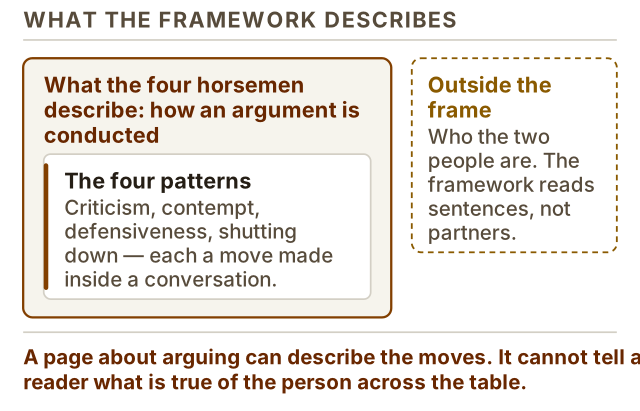
The research behind the framework was done with couples, so that is where its evidence lives. But the four patterns describe how conflict is conducted, not something unique to romance, and people recognise them readily in friendships, families, and workplaces. Treat the framework there as a useful lens rather than a research finding about those settings.
The translation is imperfect in one important way: the counter-moves assume a relationship both people intend to keep, with room for repair and shared history to draw on. Consider a colleague who answers your point with contempt: they are showing you the same behaviour Gottman coded in couples, but the remedies available to you — and the stakes of naming the pattern aloud — are different. Use the framework at work to understand what is happening; be careful importing the couple-specific advice unchanged.
What type of person gives the silent treatment?
The research answer is unsatisfying if you want a villain: there is no silent-treatment personality type. Gottman’s work links shutting down to two things. Flooding is being too physiologically overwhelmed to keep engaging — the state measured in Levenson and Gottman’s research on the physiology of conflict; the other is habits learned in homes where conflict was unsafe or pointless. In practice, the same person can go silent with a partner and argue fluently at work.
That does not mean the silence is harmless or that you must simply absorb it. It means the useful question is not what kind of person does this but what is the silence doing in this relationship — is it a pause that ends and leads back to the conversation, or a wall that never comes down? The behavioural picture, and why Gottman’s work describes the shutdown as overwhelm rather than strategy, is covered in full on our stonewalling guide.
Is stonewalling passive-aggressive?
Not necessarily, though it can be. Stonewalling in Gottman’s sense is a shutdown driven by overwhelm — the person goes quiet because they cannot keep engaging. Passive-aggressive silence is a message sent on purpose: punishment delivered by withholding. The behaviours look identical from the outside; the difference lies in whether the silence is a refuge or a weapon.
From inside the argument you cannot always tell which one you are facing, and you do not have to decide on the spot. The more practical distinction is what happens next: overwhelm responds to a structured break with an agreed time to return; punitive silence tends to ignore the break and extend the sentence. How to propose that break, and what separates stonewalling from the silent treatment, is the subject of how to respond to stonewalling.
What this page does not do
- Sort people into types
- None of these answers will tell you what kind of person your partner is. The framework describes behaviours that anyone can produce under enough stress, and every page on this site keeps to that level.
- Put numbers on the patterns
- Percentages and ratios attributed to Gottman circulate widely in reworded forms. Until we can verify a figure against its primary source, we describe the research qualitatively and link the sources instead.
- Replace the full pages
- Each answer here is the short version. Where an answer and its full page seem to disagree, the full page is the one written with room for the exceptions.
- Speak for the researchers
- We are an independent editorial guide. We describe John and Julie Gottman's published work with attribution; we are not connected to, certified by, or endorsed by them or their organisation.
The research these answers draw on, and where to read it directly, is listed on our sources page.