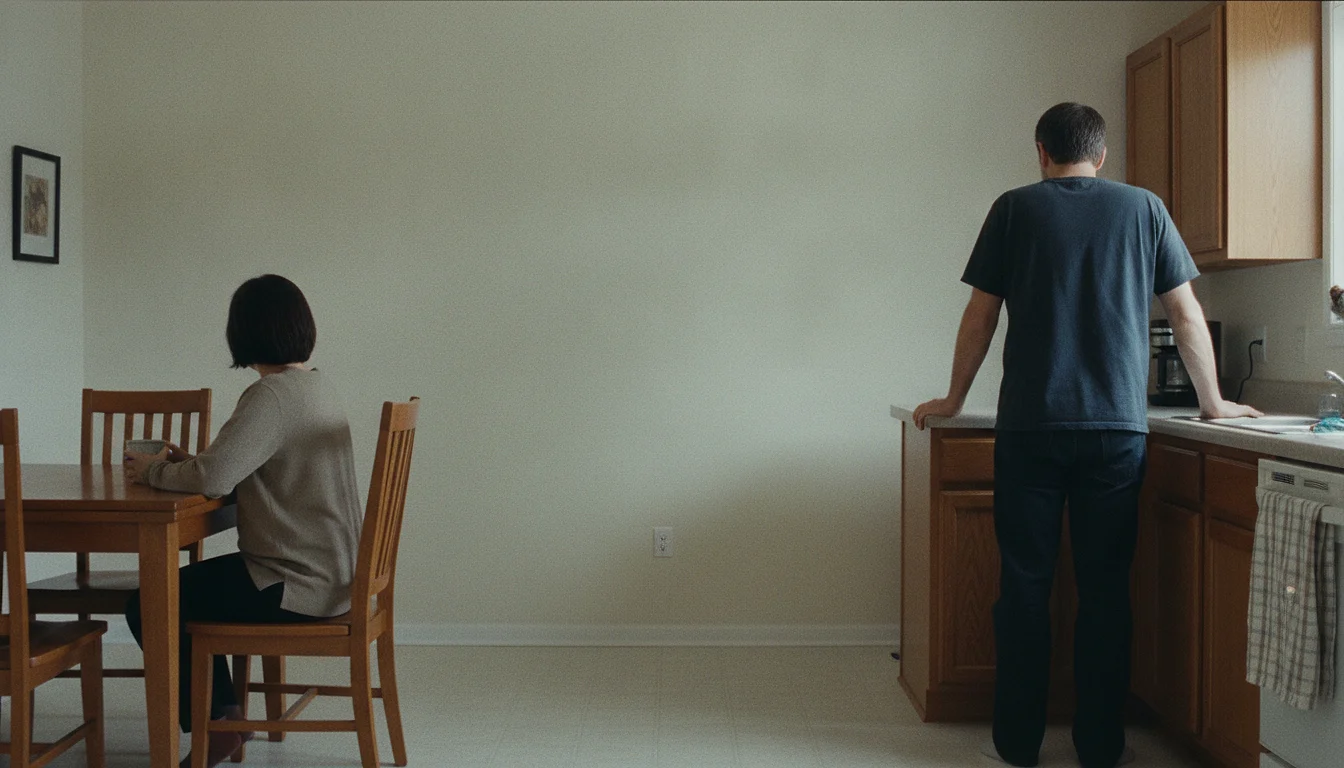
How to respond to stonewalling is mostly a matter of doing less, earlier: lower the pressure, name a pause, fix a time to return, and keep it. When a partner goes silent mid-argument — one-word answers, a turned back, a room left — the instinct is to raise the volume until something comes back. That instinct is the one thing on this page that reliably makes the wall thicker. What helps instead has a shape: pressure down, pause named, appointment made, appointment kept. This page walks through that shape, the words that fit it, and the distinction that decides which version of it you need — because stonewalling and the silent treatment look alike from the outside and ask for different responses.
Stonewalling is one of the Four Horsemen — researcher John Gottman’s name, set out in the Gottman Institute’s description of the four horsemen, for the conflict patterns his team kept meeting in couples whose relationships later ended. In that research, stonewalling tends to arrive after the other horsemen, and it is the horseman associated with the listener rather than the speaker. What it looks like, and why it tends to start as overwhelm rather than strategy, is covered in the main stonewalling guide; this page is for the person standing in front of it.
Why does pushing harder make stonewalling worse?
Pressing a stonewalling partner to respond deepens the shutdown, because the shutdown is not a refusal to engage — it is what an overloaded nervous system does when a conversation has exceeded what it can process. More volume, more questions and more following from room to room add load to a system that went silent precisely because the load was already too high.
Gottman’s research describes the state underneath as flooding — the arousal measured in Levenson and Gottman’s work on the physiology of conflict: the body treats the argument as a threat, and thinking narrows to getting through it. A flooded person is not weighing your words and declining to answer them. They are, for practical purposes, not fully in the conversation any more — which is why the most accurate and least satisfying description of a stonewalling partner mid-shutdown is unavailable, not unwilling.
This is also why the standoff escalates so predictably. From the outside, the wall reads as contempt or indifference, so the shut-out partner speaks louder, sharper, closer. From the inside, that intensity confirms the sense of threat, so the wall gets higher. Each person is responding reasonably to what the other’s behaviour looks like, and the loop feeds itself. Nobody has to be the villain of this loop for it to run.
The practical conclusion is uncomfortable but simple: in the moment, you cannot argue, insist or reason a stonewalling partner back into the conversation, because the route back runs through their physiology, not your phrasing. What you can control is the load. Lowering it is not conceding the argument. It is the only move that shortens the wall instead of lengthening it — and it works best when the lowering has a structure, which is the next section.
What should you do when your partner stonewalls you?
Stop adding pressure and offer a structured break. The structured break is a pause with a fixed shape: both people agree to stop, both know when the conversation resumes, and both actually resume it. The agreement makes the pause different from walking out; the named return makes it different from avoidance. Without the return, a break is just stonewalling with better manners.
The practice comes from the same research tradition as the framework itself, listed on our sources page: Gottman’s work with couples pairs the shutdown with deliberate breaks that let the body settle before the conversation continues. We describe it here as a conversational practice, not a clinical protocol — there is nothing to administer, only an agreement to make before you need it.
The pieces, in order:
Agree on the tool in peacetime. A break proposed for the first time mid-argument sounds like an escape hatch. A break the two of you agreed on last month, with its own words and its own rules, sounds like the plan working. The best version of this conversation happens on a calm evening, not at the top of a fight.
Name it without a verdict. The pause is called, not inflicted. For example, “I can see this has hit a wall — let’s stop and come back to it” does the job. “Fine, forget it” does a different job: it converts the pause into a fresh wound and guarantees the return never happens.
Fix the return before you separate. For example, “later” is not a return; it is a hope. “After dinner” or “tomorrow morning before work” is a return. The named time is what lets the overwhelmed partner actually stand down — the conversation is scheduled, not lost — and what lets the shut-out partner release the fear that silence has become the answer.
Spend the break settling, not rehearsing. A break used to polish your opening argument is a ceasefire used to reload. The point of the pause is that both people come back with a calmer body than they left with. Do something genuinely elsewhere: walk, shower, music, anything that is not the argument continued internally.
Keep the appointment. This is the whole mechanism. A kept return teaches both people that pausing is safe — that the topic survives the silence. A skipped return teaches the opposite, and after a few skipped returns the shut-out partner will fight the pause itself, reasonably.
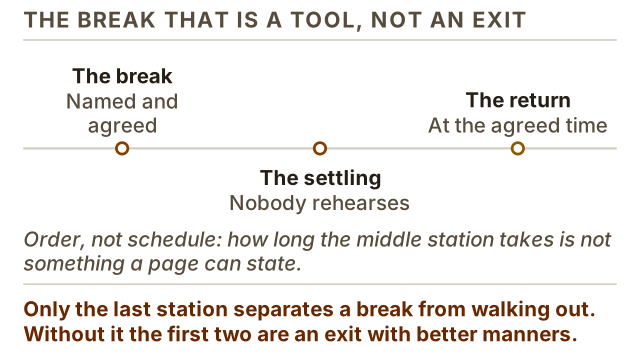
How long should the break be? Long enough for the body to genuinely settle, short enough that the return happens the same day wherever possible. We are not attaching a number to that, because the honest answer varies by person and by fight — the test is not the clock but the state you come back in. If you return and the wall goes straight back up, the break was too short, whatever it measured.
What can you say to someone who is stonewalling you?
The words that help during a shutdown are structural, short and free of verdicts: they name the wall, offer the pause, and fix the return. The words that hurt are evaluative or urgent: they characterise the silent partner or demand engagement now, and both read as new pressure on a system that shut down under the old pressure.
Phrases that tend to lower the wall:
- “I can see you’ve shut down. Let’s stop here and come back to this after dinner.” Names the state without blame, proposes the structure, fixes the return. This is the whole method in one sentence.
- “This matters to me, and I want to talk about it when we’re both actually able to.” Keeps the topic alive — important for the person calling the pause — while conceding that now is not that time.
- “I’m not going anywhere. Take the time you need, and let’s pick it up tonight.” Addresses the fear that often sits under a shutdown: that the conversation is a threat to the relationship rather than a problem inside it.
- “Was that too much at once? Tell me when you’re ready to try again.” Useful when you suspect your own delivery contributed to the overload — an honest question, not a confession extracted under pressure.
Phrases that tend to raise it:
- “You’re doing it again.” Accurate, perhaps, but delivered as a charge sheet. The observation lands better without the again, which converts a description into a verdict on their character.
- “Say something. Anything. Talk to me right now.” The demand for immediate engagement is the exact input the shutdown protects against. Urgency here buys silence.
- “If you loved me, you wouldn’t shut me out.” Ties the physiological state to the relationship’s worth, which raises the stakes of a conversation that stalled because the stakes already felt too high.
- “Fine. Silence it is.” A counter-wall. Two people stonewalling each other is not a pause; it is the conversation ending without anyone deciding to end it.
One honest caveat about scripts: none of these lines works as an incantation, and a phrase delivered through clenched teeth carries the clenched teeth, not the phrase. The words matter less than what they encode — no verdict, lower pressure, guaranteed return. Say it however you would actually say it.
What is the difference between stonewalling and the silent treatment?
Stonewalling and the silent treatment produce the same surface — a partner who will not engage — but they run on different fuel. Stonewalling is an overwhelmed state that shuts a person down mid-conflict; the silent treatment is a chosen tactic that uses withheld contact to punish or to extract something. The difference is direction: one is a retreat, the other is aimed.
That difference is hard to read in the moment, partly because the person behind the wall may not be able to narrate their own state, and partly because a retreat can feel like punishment from the receiving end regardless of intent. The more reliable signals live in the pattern around the silence, not in the silence itself.
| Signal | Stonewalling | Silent treatment |
|---|---|---|
| What starts it | A conflict that exceeds what the person can process | A grievance, and a decision about how to answer it |
| What it looks like inside | Overwhelm; the silence is a symptom | Control of the situation; the silence is the instrument |
| Scope | This conversation, this fight | Can extend across days and unrelated contexts |
| Response to a genuine pause | The wall softens once pressure drops | The silence continues — the pause was not the point |
| The return | Possible — and a relief to both when it comes | Withheld until the silent partner gets what the silence was for |
| What it asks of you | Lower the load, schedule the return | Name the pattern in a calm moment, and decide what you will accept |
The most useful diagnostic in that table is the second-to-last row. Offer a real, structured pause with a named return. Consider a flooded partner: they can take it, settle, and come back — maybe awkwardly, but back. A partner running the silent treatment has no use for your pause, because ending the silence was never the obstacle; the silence is doing a job, and it continues until the job is done.
Be careful with the conclusion you draw even then. A single unread signal is not a verdict on a person, and plenty of silences are mixed: a shutdown that hardens into a grudge, a tactic that started life as genuine overwhelm. What the distinction changes is your next move — the structured break for the flooded partner, a direct conversation about the pattern itself for the aimed one — not your diagnosis of who you married.
When it keeps happening
Everything above is a response for the moment, and moments are not where this pattern is won. If the wall goes up in hard conversation after hard conversation, the useful work moves upstream: the person who shuts down learns to catch the overload before it closes them (that side is written for them in how to stop stonewalling), and both partners get better at raising hard topics below the threshold that triggers the slam.
The repair side of that upstream work has its own toolkit. Gottman’s research pays particular attention to the small mid-argument moves — an apology, a softened restart, a moment of humour — that stop an escalation before it reaches the wall. Those are collected in the guide to repair attempts, and they are worth learning in peacetime for the same reason the structured break is: none of these tools can be invented mid-fight.
And if what you are living with does not match this page — silence that extends for days, follows you into unrelated parts of life, or lifts only when you concede — then the overwhelm frame may simply be the wrong frame for your situation. The honest boundary of this page is that it describes a conflict pattern, not your relationship. Where the line sits between a shutdown and something more deliberate is treated carefully and separately in is stonewalling abuse?, which is also where we say plainly what a website can and cannot tell you about that question.
What this page does not do
A response guide is a narrow tool. Here is what it deliberately leaves out.
- Make your partner talk
- There is no phrasing on this page that produces engagement from someone who is shut down, and we do not publish techniques for changing another person's behaviour. Everything here manages the conditions around the shutdown; the coming back is theirs to do.
- Diagnose the silence
- The stonewalling / silent-treatment distinction is a reading aid, not a verdict. This page cannot tell you which one is happening in your kitchen, and a single incident proves neither. Patterns over time are the only honest evidence, and even those are yours to weigh, not ours.
- Promise the break works
- The structured break is the best-documented response we know of, described in Gottman's research on flooded couples. It is still a practice two specific people have to run, and no page can guarantee what it produces in your relationship.
- Stand in for outside help
- Where silence is chronic, frightening, or tied to control, the questions worth asking go beyond what an editorial guide can responsibly answer. That threshold, and where to go past it, is the subject of the is-it-abuse page — not a paragraph here.
What it is for
- The next shutdown
- A concrete sequence — pressure down, pause named, return fixed, return kept — that you can carry into the moment where instinct says push.
- Words that fit the moment
- Lines that name the wall without indicting the person behind it, and the reasons the usual lines backfire.
- Reading the pattern
- A way to tell a retreat from a tactic over time, so your response matches what is actually happening.
The reading behind this page — the Four Horsemen framework, flooding, and the research on breaks and repair — is listed with the rest of our references in sources. We re-check the pages in this series on a rolling basis; this one was last reviewed on the date above.