
People who type “is stonewalling abuse” into a search bar are not asking an abstract question. Something happened — a wall of silence in the middle of a conversation that mattered — and they are trying to find out what to call it. This page will not hand down a verdict, because no page honestly can. What it can do is describe the difference between two silences that look identical from the outside, and give language for testing which one is in the room.
The short version: stonewalling is a conflict behaviour — the shutdown John and Julie Gottman named as the fourth of their four horsemen — and on its own it is not evidence of abuse. Gottman’s research describes it as overwhelm wearing a blank face. But silence can also be used as an instrument, and the difference is not in how the silence looks. It is in what the silence does.
Is stonewalling a form of abuse?
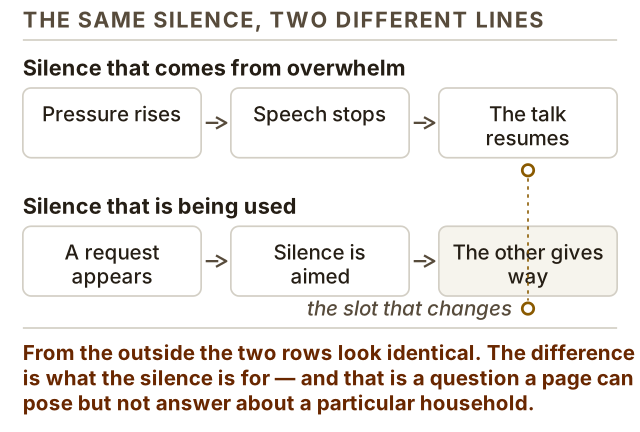
Not by itself. The distinction that matters is function, not form. One silence happens to a person: their system floods, engagement becomes impossible, and the shutdown ends when the pressure ends. The other silence is done with a purpose: it is withheld contact, aimed at an outcome, and it ends when it gets what it was aimed at. The same closed face can belong to either.
Gottman’s research, listed on our sources page and including Levenson and Gottman’s work on the physiology of conflict, describes stonewalling as the behaviour of someone who is physiologically overwhelmed — flooded — and no longer able to take in what is being said. That version is involuntary in the way a stalled engine is involuntary. The person is not choosing silence as a message; they have run out of capacity to respond. The emotional effects on the person facing that wall are real and worth taking seriously, but the wall itself is a symptom of overload, not a strategy.
The second silence has a different anatomy. It is selective — for example, it appears with a partner but not with a boss, in private but not in front of friends. It is responsive to concessions: it lifts when the other person apologises, backs down, or stops asking. And it is durable against boundaries: naming it calmly and asking for a return time changes nothing, or makes it longer. That silence is functioning as a lever, whatever name anyone gives it.
One more thing before the criteria, because it matters to the person asking: the question itself is data. Going looking for the word “abuse” is a sign that something in the pattern has started to feel unlivable. Searching for it does not mean the answer is yes — it may be the pain of the wall talking, not the wall’s intent — but that feeling deserves attention whichever silence turns out to be in the room. The mistake to avoid is settling the question from one bad night. A single bad argument can produce a shutdown in people with no pattern at all; the two silences only become distinguishable across time.
Three questions separate the two, and none of them can be answered from a single argument:
- Repetition. Does the silence show up under genuine overload, or selectively — deployed in some situations and absent in others where the stakes are just as high?
- Function. What ends the silence? Calm and time, or a concession from the other person? What a behaviour reliably ends on is the closest thing to its purpose.
- Response to a boundary. When the silence is named without accusation and a return to the conversation is requested, does the pattern soften over time — or hold and harden?
| What to watch | Overwhelm (shutdown) | Silence used as a lever |
|---|---|---|
| When it appears | Under load: mid-conflict, when intensity spikes | Selectively: with some people, over some topics, regardless of intensity |
| What ends it | Calm, time, a break with an agreed return | A concession: an apology, a dropped request, giving in |
| After a calm boundary | The pattern can soften as breaks become normal | The pattern holds, or the silence gets longer |
| The person's account | Describes being flooded, blank, unable to find words | Reframes the silence as deserved, or denies it happened |
Is stonewalling manipulation?
Stonewalling is manipulation only when silence is doing a job. The test is not sincerity — people cannot be relied on to announce their own motives, even to themselves — but consequence: if the silence reliably ends when the other person gives something up, it is operating as pressure, whether or not anyone planned it that way.
This is worth saying carefully, because “manipulation” is a word that gets attached to any behaviour that hurts. Being shut out hurts regardless of why it happens. But a flooded person who goes quiet is not extracting anything from their partner; they are failing to cope, visibly. The silence-as-lever pattern is different in a way the receiving partner can feel before they can name it: the silence has terms. There is something specific that would end it, and both people know what it is.
There is also a middle territory that deserves honesty: a habit can drift. A silence that began as genuine overwhelm can, over years, become the move that ends every difficult conversation — not because it was ever aimed, but because it worked. Consider a couple where this has happened: one partner insists they shut down helplessly, the other experiences the shutdown as a door closed in their face, and both are describing the same events accurately. That drift is one reason responding to stonewalling with structure — a named break, an agreed return — matters: it gives an involuntary shutdown a way to end that is not a concession, and in doing so it also reveals which kind of silence it was.
Is stonewalling a trauma response?
Stonewalling can resemble a trauma-linked freeze response, because both involve a nervous system shutting down under a load it reads as threat. But resemblance is not identity, and whether one person’s silence traces back to their history is a question for a professional who knows that history — not for an article that has never met them.
People reaching for this question may be asking something gentler than the last section’s: not “is my partner doing this to me” but “is something being done to my partner by their own history”. It is a humane question, and it deserves an honest shape rather than a yes.
What can be described is the mechanism. Flooding is a state of physiological overwhelm in which taking in new information becomes genuinely difficult, and it is the shutdown at the centre of stonewalling. Gottman’s research describes flooded partners as unable to engage, not unwilling. That state resembles what trauma literature calls a freeze response, and for some people the two are connected: a history in which conflict was dangerous can make an ordinary argument feel like an emergency, and shutting down is what an emergency response looks like when there is nowhere to run.
But “resembles” is where an editorial page has to stop. Whether one person’s silence is wired to their history is a question about that person’s history — something a therapist can explore across sessions and an article cannot see at all. Two things can be held at once here: a partner’s shutdown may have origins that deserve compassion, and the person facing the wall is still allowed to find it painful and to ask for change. An explanation is not an obligation to absorb the pattern indefinitely, and compassion does not require pretending the wall costs nothing.
The line this page draws is between two descriptions of silence, not between two kinds of person. It cannot tell a reader which description fits their own household, and it is not the place to decide that: what it can do is set out the difference clearly enough to be useful in a conversation with someone who can.
How do you set a boundary around silence?
A boundary around silence is not a demand that the other person talk. It is a statement about what the speaker will do, said calmly, kept consistently. That framing matters because a demand to engage pushes a flooded person deeper into shutdown, while a boundary leaves room for the conversation to survive the pause.
A workable shape has three parts: name the pattern without accusation, state what happens next, and offer a return. In practice it sounds like:
- “You’ve gone quiet and I don’t want to talk at a wall. I’m going to stop here. Can we pick this up after dinner?”
- “When the conversation just ends without a pause being named, I’m left holding it alone. I need us to agree on when we come back to it.”
- “I can wait, but not indefinitely and not in silence. Tell me when you’re ready to continue, and I’ll hold you to it.”
What these have in common: they do not diagnose the silence, they do not punish it, and they attach a return to the pause. The return is the load-bearing part. A pause with an agreed return is a break; a pause without one is just the silence winning.
What a boundary is not: it is not an ultimatum delivered mid-fight, and it is not a script for making someone speak. No wording forces engagement from a person who has decided not to give it, and a page that sold such wording would be selling something false. The purpose of the boundary is different — it makes the silence legible. Said calmly and kept consistently, it sorts the two silences from the first section better than any single argument can: a flooded system has a reason to accept a structured pause with relief, because the pause is what it needed anyway. Silence that was doing a job has a reason to refuse the structure, because a pause with a return defeats the job.
One more audience for this section: the person reading it who recognises themselves on the far side of the wall. Realising that your silence — however involuntary it feels from the inside — is being experienced as a closed door is uncomfortable, and it is also the most useful position anyone can be in, because the shutdown is far easier to change from the inside than to push on from the outside. The work is learning to call the break before the wall goes up, and there is a separate page on how to stop stonewalling for exactly that practice.
If the boundary holds and the pattern softens, the remaining work is that same slower kind, done together. If the boundary is stated clearly, kept calmly, and the pattern holds or hardens anyway, that persistence is information. It does not come with a label attached, but it does mean the situation has outgrown self-help articles.
Where this page stops
Where this page stops
An honest information page should say plainly what it cannot do. This one reaches its edge here.
- We do not assess anyone's relationship
- This page describes patterns in general. It has never seen your relationship, and no checklist substitutes for a professional who can ask follow-up questions. If what you read here maps uncomfortably well onto your situation, that is a reason to talk to someone qualified — not a conclusion in itself.
- We do not attach labels to people
- Nothing here diagnoses a partner, and nothing here should be carried into an argument as a verdict with a citation. The distinction this page draws is between functions of a behaviour, not between kinds of people.
- If there is fear, this is the wrong page
- One criterion overrides every table above: if you feel afraid of your partner — afraid to state a boundary, afraid of what follows silence — the question has left the territory of conflict patterns, and an editorial site is the wrong tool. Free domestic-violence hotlines and services exist, and talking to one does not commit you to anything. How we choose what to point to, and why we list processes rather than clinic advertisements, is described on our sources page.
What we do stand behind
- The distinction itself
- Pattern, function, and response to a boundary are readable over time by the person living with them, and they are worth reading before adopting anyone else's label for your life.
- Your reading of your own experience
- Whatever the silence turns out to be, the pain of standing in front of it is real and does not need a diagnosis to justify taking it seriously.
How this site verifies claims and selects outside resources is documented on the sources page. For the mechanics of the shutdown itself — what flooding is and why it happens — start from the stonewalling guide; for what the pattern does to the person on the receiving end over time, see the emotional effects of stonewalling.