
Defensiveness in relationships is meeting a complaint with a counter-attack or an innocent-victim stance instead of hearing it. It is the easiest of the Four Horsemen to commit and the hardest to notice in yourself. The framework, described by researcher John Gottman, names four conversation patterns observed in couples whose relationships later ended, the work reported in Gottman and Levenson’s 1992 study of marital dissolution; defensiveness is the one that feels, from the inside, like simple fairness. You were accused. You answered.
That is what makes it durable. Criticism sounds harsh even to the person delivering it, and stonewalling is visible across a room. Defensiveness feels like justice. The person doing it would describe the same moment as “defending myself”, which is exactly the phrase that keeps the pattern invisible. This page describes what the pattern looks like in real exchanges, where it tends to come from, and the counter-move Gottman’s work pairs with it. For the frame the four patterns sit inside, start with the Four Horsemen overview.
What does defensiveness look like in a relationship?
Defensiveness is responding to a complaint by protecting yourself instead of hearing it. The protection takes familiar shapes: an excuse, a counter-complaint, a correction of the facts, or an appeal to your own innocence. Whatever the shape, the effect is the same — the original complaint is never answered, and the person who raised it is left holding it.
The important word is instead. There is nothing wrong with context, and there are moments when an accusation is genuinely unfair and saying so is right. Defensiveness is not the existence of a reply; it is the substitution of a reply for an acknowledgement. The complaint goes in, and what comes back addresses everything except the complaint.
Gottman’s published research — the material we list on our sources page — and the Gottman Institute’s description of the four horsemen describe defensiveness as a way of blaming your partner back: the underlying message is the problem isn’t me, it’s you. That message can be delivered aggressively, through counter-attack, or softly, through wounded innocence. Both versions end the same way, with the issue unresolved and both people further apart than when the sentence started.
What are examples of defensive behavior?
The common forms are whataboutism, excuse-making, the innocent-victim reply, cross-examining the wording of a complaint, and the counter-complaint. The pattern is easiest to see in short exchanges: a complaint, a defensive reply, and the gap between what was said and what was heard. For example, each of the five scenes below follows that shape. None of these people are real; the exchanges are composites of how the pattern sounds.
The excuse. Complaint: “You said you’d call the plumber this week.” Defensive reply: “Work has been insane. You have no idea what my Tuesday looked like.” What was heard: not “we have a leaking tap and I’m carrying it”, but “you are unreliable” — so the reply defends reliability and the tap stays broken.
Whataboutism. Complaint: “I felt dismissed when you looked at your phone while I was talking.” Defensive reply: “You do the exact same thing every morning.” What was heard: an indictment that must be balanced, not a feeling that could be answered. The scoreboard comes out, and the feeling never gets a response.
The innocent victim. Complaint: “Can you let me know when you’re running late?” Defensive reply: “I can never do anything right, can I.” What was heard: total condemnation. The reply converts a small request into proof of persecution, and now the person who made the request is comforting the person who was late.
The cross-examination. Complaint: “You’ve been distant all evening.” Defensive reply: “Distant how? Name one specific thing I did.” What was heard: a charge to be beaten on the evidence. The reply may win the exchange on technique and still lose the evening, because the distance was real and remains unaddressed.
The counter-complaint. Complaint: “I wish you’d asked me before inviting your brother.” Defensive reply: “At least my family visits. When did yours last make the trip?” What was heard: an attack on family loyalty, met with escalation. Two complaints are now open, neither will be resolved tonight, and the original one has vanished entirely.
What links these scenes is the loop underneath them:
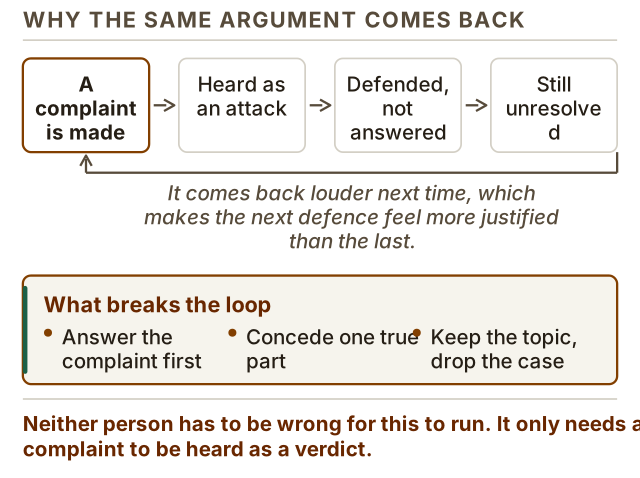
The loop explains why defensive couples have the same argument on repeat. The topic recycles because it was never actually closed, and each pass raises the volume, which makes the next defensive reply feel more reasonable to the person giving it.
Where does defensiveness come from?
The root of defensiveness is a translation error: a complaint about a behaviour is heard as a verdict on the person. A complaint about a behaviour arrives, and somewhere between the ear and the reply it becomes a complaint about the person. “You forgot the appointment” is heard as “you are careless”, and careless is worth defending against in a way that a missed appointment is not.
Some of that translation is learned. People who grew up around harsh or constant criticism often describe developing a fast reflex for self-protection long before their current relationship existed; the reflex simply came along. Others learned it inside the relationship itself: if complaints here have historically arrived as character verdicts, treating the next one as an attack is not paranoia, it is pattern recognition.
This is also where defensiveness connects to the other horsemen. It tends to arrive as an answer to criticism — the more a complaint is phrased as a defect in someone’s character, the more defensible defending feels. The two patterns feed each other, which is why working on how complaints are raised and working on how they are received can turn out to be the same project seen from opposite ends.
None of this makes the reflex a diagnosis or a character trait. It is a habit of hearing, and habits of hearing are describable and, in Gottman’s framing, changeable — which is where the counter-move comes in.
How do you stop being defensive?
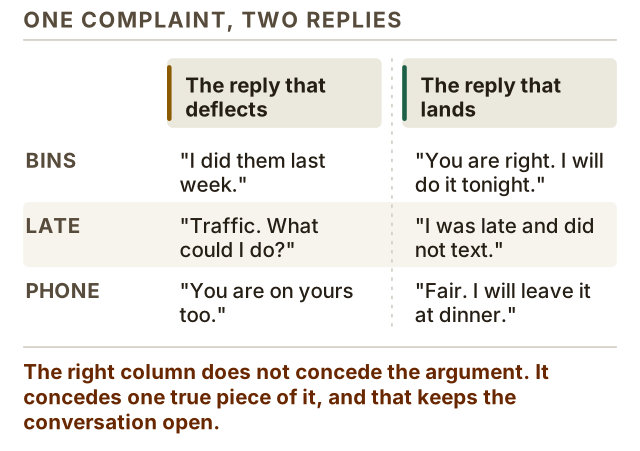
You take responsibility for some part of the problem before you defend the rest. Accepting a sliver of responsibility means acknowledging the part of a complaint that is genuinely yours without conceding the whole of it, and it is the counter-move Gottman’s work pairs with defensiveness. Not the whole problem, and not a performed apology — a genuine acknowledgement of the part that is actually yours. Consider the uncalled plumber: “You’re right, I did say I’d call this week” is a complete answer. Nothing more is required for the move to work.
The mechanism is directional. A defensive reply sends the conversation into dispute: now the couple is arguing about whether the complaint was fair, which is a second argument stacked on the first. An acknowledgement sends it toward resolution: the complaint has been received, so it does not need to be repeated louder. The loop in the figure above breaks at its second arrow — the complaint is heard as a complaint, and the escalation never gets its fuel.
Accepting a sliver is not the same as conceding everything. You can acknowledge the missed call and still say the “you never follow through” framing felt unfair; that conversation goes better after the acknowledgement, not instead of it. Order matters. Defensiveness puts the self-defence first and the hearing never; the counter-move puts the hearing first and lets the fairness discussion follow.
It also pairs naturally with the wider toolbox. An acknowledgement mid-argument is one form of what Gottman calls a repair attempt — a bid to stop escalation before it runs. The repair attempts page covers that family of moves, including why noticing a partner’s repair matters as much as making your own.
What do you do when your partner is constantly defensive?
If your partner is the defensive one, the honest starting point is a boundary of expectation: you can change the conditions around the reflex, and you cannot change the reflex for them. Pages that promise otherwise are describing a partner who has already decided to work on it.
What the conditions are worth: complaints that begin with a specific situation and your own need — rather than with “you always” or “you never” — give the translation error less to work with. That is not a technique for managing your partner; it is the same gentle start-up described on the criticism page, applied for your own reasons. A complaint that is hard to hear as a character attack is easier to receive as what it is — a comment on a situation.
Timing helps in the same modest way. Naming the pattern works better outside arguments than inside them. For example, “I’ve noticed when I raise something, we end up debating whether I was fair to raise it” is a describable observation on a calm Tuesday and an accusation at full volume on a bad Friday.
And there is a limit worth stating plainly. If every complaint, however carefully phrased, is met with counter-attack, and the pattern never moves regardless of conditions, that is information about the relationship’s current state, not about your phrasing. A page cannot tell you what to do with that information, and this one will not pretend to. Where a couple wants outside help with entrenched patterns, that is a conversation with a qualified professional, not with a website.
What this page does not do
Search results for defensiveness are full of practices with clinical framing. This is an editorial guide, and its limits are part of the description.
- No clinical promises
- Nothing here is therapy, a protocol, or a treatment. The counter-move described above comes from Gottman's published framework and is presented as a conversational practice, with no promised outcome for any particular couple.
- No diagnoses
- Defensiveness is a conversation pattern, not a condition or a character type. This page does not assess you or your partner, and being described by it says nothing clinical about either of you.
- No scripts for changing your partner
- The section on living with a defensive partner describes conditions and limits, not levers. There are no sentences here designed to produce a specific reaction in another person.
- No affiliation
- The Four Horsemen framework belongs to researchers John and Julie Gottman. This site is an independent editorial guide with no connection to, certification from, or endorsement by the Gottman Institute. How we verify claims is on the sources page.
How this page was checked: every claim about the framework is attributed to Gottman’s published research, and this site publishes no statistics it has not verified — the process is described on the sources page. Checked: 2026-09.