
The Gottman repair checklist is a reference tool from John and Julie Gottman’s work: a written collection of short phrases a couple can reach for mid-conflict, grouped by what each phrase does. People come to it looking for a printable list of magic phrases. The honest news first: the checklist exists, it belongs to John and Julie Gottman, and you can get it from them — we describe it below rather than copying it. The better news: the skill the checklist trains does not live in the wording. It lives in a small, learnable exchange called a repair attempt, and in Gottman’s research on the Four Horsemen — the framework this whole guide covers, and the subject of Gottman and Levenson’s 1992 study of marital dissolution — what separated lasting couples was not that they argued less. It was that their repairs got noticed.
What is a repair attempt?
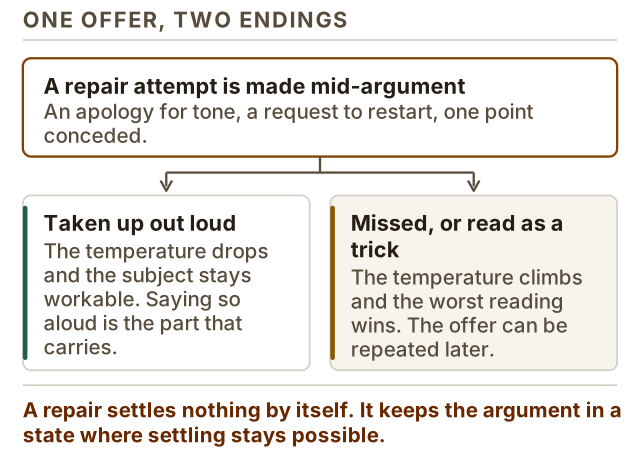
A repair attempt is any word or gesture, offered mid-conflict, whose function is to slow the escalation rather than win the point. It is the argument’s built-in exit: a bid to step off the ramp without pretending the disagreement is over. The term comes from Gottman’s observational research, and the behaviour it names shows up in ordinary arguments long before anyone has a word for it.
Repairs are easy to miss in a transcript because they do not sound like peace talks. For example, in real arguments they sound like this:
- The tone apology. “Okay, that came out harsher than I meant. Let me try again.”
- The restart. “Wait — can we rewind? I started this badly.”
- The inside joke. A line from a shared story, deployed at the worst possible moment, daring both of you not to smile.
- The touch. A hand on a shoulder or a knee while the sentences are still sharp.
- The confession of state. “I’m getting overwhelmed and I’m about to say something dumb.”
- The small concession. “You’re right about the part with your mother. The rest I still disagree with.”
None of these resolves the topic. That is the point: a repair attempt does not settle who is right, it keeps the argument in a range where settling it stays possible. Which is why the interesting question is not whether your relationship contains repairs, but what happens to them next.
Why do repair attempts get missed?
Repairs fail mostly because they are never received. A repair attempt only works if it is received, and reception is exactly what escalation destroys. As an argument heats up, both nervous systems drift toward flooding — the overwhelmed state, measured in Levenson and Gottman’s work on the physiology of conflict, in which attention closes down and everything the other person says gets sorted into attack or retreat. A joke arrives and gets filed as mockery. A concession arrives and gets filed as a trick. The olive branch is scanned for thorns.
This is the quiet tragedy Gottman’s team describes: in escalating conflicts, repairs are still being offered. They are being offered into a connection that has already dropped. The sender concludes that gentleness does not work on their partner; the receiver never registers that gentleness was tried. Both walk away with evidence for the bleakest reading of the other.
Flooding is also where repair attempts connect to the fourth horseman. A person who shuts down mid-argument has sailed past the point where any repair could reach them — which is why the counter-move for shutdown, the structured break, is really a repair attempt of its own: a way of leaving that includes the route back. If you are the partner who goes silent, how to stop stonewalling covers that practice in detail. The rule of thumb from both pages is the same: repairs need a hearable moment, and sometimes the first repair is making one.
What is in the Gottman Repair Checklist?
The Gottman Repair Checklist is the tool John and Julie Gottman built around this exact problem. It is not a script for the perfect apology; it is a written collection of short, plain phrases a couple can reach for when their own words have gone sharp, organised into groups by what each phrase is for — some name what the speaker is feeling, some apologise, some ask for a pause or a slower pace, some appreciate, some move the couple toward common ground. The structure is the lesson: it teaches you to recognise the move behind the words.
In practice the checklist gets used in a way that surprises people: openly. Couples in Gottman-based exercises keep it in view during a disagreement and literally point at the kind of thing they are trying to say. That sounds artificial, and it is — deliberately so. Saying a borrowed phrase flags it unmistakably as a repair, which solves the missed-signal problem from the previous section. It is hard to file “I’m reaching for the calm-down column” under attack.
We are not reproducing the checklist here, for a plain reason: the wording is its authors’ work, and this site is an independent editorial guide with no affiliation to the Gottman Institute. The original is available from the rights-holder, and our sources page lists where the framework’s materials come from. What no printout can carry is the other half of the tool — the agreement, made in peacetime, that repairs will be watched for. A checklist on the fridge of a couple that has never discussed it is just paper.
How do you make a repair attempt land?
If you already make repair attempts and they keep dying on arrival, the place to look is packaging, not sincerity. Certain patterns show up again and again in what makes a repair land or miss.
Send it clean. A repair wrapped in a jab is a jab. Consider “I’m sorry I snapped — but you’d make a saint snap”: it cancels itself in transit. If you cannot yet say the repair without the rider, you are not ready to send it; that is useful information about your own flooding.
Send it early. Repairs work best on the ramp, not at the summit. The moment you notice the conversation sharpening — voices up, sentences starting with “you always” — is the moment a light repair still reads as light. The same words arrive very differently after the door slam.
Make it unmistakable. Mid-conflict, subtlety is a tax you cannot afford. Humour and touch are powerful repairs between partners who trust them, and risky ones where trust is thin. When in doubt, label the move: “I’m trying to de-escalate, not dodge the topic.” Clunky and received beats elegant and missed.
Match it to the wound. If the sharp thing you said was a character verdict — the pattern covered in criticism — the repair has to reach the verdict, not just the volume. “Let me say that again about the dishes, not about you” repairs the right layer.
One more honest note: repairs are easier to aim when you know the terrain. Knowing what your partner is currently stressed or tender about — the ongoing practice covered in love maps — is what makes the difference between a repair and a guess.
Accepting a repair you noticed
The receiving half of the skill gets less airtime, and it is the half Gottman’s research puts the weight on: a repair attempt only counts when it is accepted, and accepted visibly. Noticing your partner’s clumsy olive branch and privately deciding to be less angry is generous — and invisible. From their side, the repair simply vanished, and senders whose repairs keep vanishing eventually stop sending.
Accepting does not mean conceding the argument. It means answering the move, out loud, before returning to the topic: “Okay. Restart accepted.” A laugh at the bad joke. Taking the offered hand even while saying “I’m still upset about the weekend.” The topic stays open; the temperature drops. That combination — acceptance of the person, persistence on the issue — is the whole trick, and it is a hard one to pull off while angry.
| The repair arrives | Accepting it visibly | Missing or refusing it |
|---|---|---|
| A tone apology | "Thank you. Go again — I'm listening." | "Oh, NOW you're sorry." |
| A joke or a touch | Letting the smile happen, then continuing | "Don't try to be cute right now." |
| A request to pause | "Yes — after dinner, and we finish this." | Blocking the exit and pressing on |
| A small concession | "I appreciate you saying that part." | Using the concession as ammunition |
The hardest case is the repair that arrives while you are flooded yourself, when accepting anything feels like losing. For that moment, the best available answer is a hybrid: accept the repair and take the break. “I hear you trying. I’m too worked up to do this well — give me until after dinner and I’m back.” That sentence receives the repair, protects you, and keeps the route back — which is everything this page has to teach, folded into a single sentence.
What this page does not do
A page about a conversational practice, from an editorial team. Its limits are worth stating plainly.
- Reproduce the checklist
- The Gottman Repair Checklist is its authors' copyrighted work. We describe its structure and purpose and point you to the rights-holder; we do not host, excerpt, or paraphrase-in-full a document that belongs to someone else.
- Promise that repairs rescue a relationship
- In Gottman's research, received repairs distinguish couples who last — that is a description of a pattern, not a guarantee. No phrase list overturns a relationship's larger conditions, and we will not pretend otherwise.
- Score your relationship
- A page cannot count your repairs or judge your partner's misses. If reading this produced a tally of everything they fail to accept, note that building the case is itself one of the escalating moves.
- Stand in for a clinician
- Repair attempts are a conversational practice, not treatment. If conflict in your relationship involves fear or feeling unsafe, that belongs with a professional, not with a checklist of any kind.
The framework and research summarised here are listed in sources, together with how we read them. Repair attempts, the Repair Checklist, and the Four Horsemen belong to John and Julie Gottman’s body of work; we describe that work as an unaffiliated editorial guide, with no connection to the Gottman Institute.