
If you are the person who goes quiet — who gives clipped answers, stares at a fixed point, or leaves the room while your partner is mid-sentence — this page is for you. How to stop stonewalling is a matter of catching the shutdown early: notice the physical markers of flooding, call a pause out loud with a stated time to return, calm the body, and come back. It is a different question from how to stop an argument. The argument is not the problem; the wall is. What the wall looks like from the outside is covered in our stonewalling guide; what it does to both of you over time is covered in the effects of stonewalling. This page covers the part only you can do: catching the shutdown before it happens.
Why do you shut down?
Stonewalling starts in the body, not in a decision. In the Four Horsemen — John Gottman’s framework of conflict patterns, described in the material on our sources page — the shutdown is linked to what his team calls flooding, the arousal described in Levenson and Gottman’s research on the physiology of conflict. Flooding is the state in which the nervous system reads the argument as a threat and switches into self-protection: thinking narrows, hearing gets selective, and the options that remain feel like silence or escape.
That reading matters, because it changes what “stopping” means. From the outside, stonewalling looks like a choice to punish. From the inside, it may not feel like a choice at all — more like the conversation became impossible. Both descriptions are partly true: the flooding is not chosen, but what you do about it is. The classic mistake is trying to fight the flooding with willpower, staying in the room while increasingly unable to process a word of it. That is not presence; it is a wall with eye contact.
So the goal is not “never need a pause”. The goal is to move the pause earlier and make it visible: notice the overwhelm while you can still speak, say what is happening, and leave the conversation in a way that includes a route back. Everything below is a version of that move.
How do you catch flooding before you shut down?
You learn your own early markers and treat any one of them as the cue. The shutdown has a run-up, and the run-up is where you still have options. The markers differ from person to person, but the reports cluster around the same short list. Learn yours in calm moments, because you will not discover them mid-argument.
- Heart and breath. A pounding or racing heart, breath going shallow or held. The marker that tends to show earliest.
- Heat and tension. A hot face, clenched jaw, shoulders up around the ears, hands gripping whatever they hold.
- The blank mind. You are asked a direct question and there is nothing there — not refusal, just static where the answer should be.
- Rehearsal instead of listening. You notice you are composing a defence, or replaying an earlier line, while your partner is still talking.
- The exit fantasy. A sudden, detailed interest in being anywhere else: the drive, the garage, the phone.
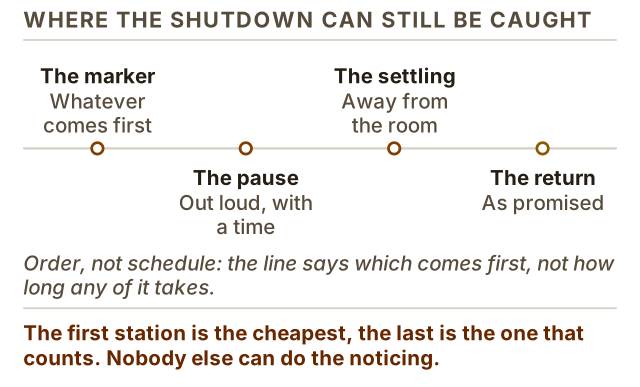
Any of these is a cue, and every cue means the same thing: the window for a good pause is open and closing. Waiting to be sure is how the window shuts. The move that follows is not dramatic — it is a sentence you have prepared in advance, which is the subject of the next section.
How do you actually end stonewalling?
You replace the silent exit with an announced pause that has a return time attached. The structured break is the counter-move Gottman’s work pairs with stonewalling — the practice written up for couples in The Seven Principles for Making Marriage Work — and it is a conversational practice, not a therapy technique. Its parts are plain, and stonewalling is what you get when any of them is missing: say that you are overwhelmed, ask for the pause out loud, and name when you will come back. Then come back.
The sentence is worth writing before you need it, because flooding takes your vocabulary first. For example, something plain does the job: “I’m too flooded to do this well. I need a break. Let’s come back to this after dinner.” Notice what the sentence is not. It is not a verdict on the argument, not “this conversation is pointless”, not a door closing. It marks the topic as unfinished and yourself as returning.
The return time is the load-bearing part. A break with no stated end is, from your partner’s side, indistinguishable from the silent treatment — the same absence, the same guessing. A break with a named end is a promise, and keeping it is what teaches your partner that your pauses are pauses, not exits. Agree the shape of this in peacetime: what the phrase will be, roughly how long breaks last, and that the topic returns by default.
| Structured break | Silent exit | |
|---|---|---|
| How it starts | Announced out loud, before the shutdown | Unannounced; the other person discovers it |
| What is named | The overwhelm, the pause, the return time | Nothing — the silence has to be interpreted |
| During | Calming the body, away from the argument | Rehearsing the argument, or avoiding it entirely |
| How it ends | You come back and reopen the topic | The topic is dropped and resurfaces later, worse |
What should you do during the break?
What you do during the break decides whether it works. Flooding does not end because you left the room; it ends because your body gets time and material that is not the argument. The classic way to waste the break is rehearsal — walking in circles composing the comeback, re-running the unfair line, building the case. That keeps the alarm ringing, and you return as flooded as you left, now with a script.
In practice, what tends to work is deliberately boring and physical: slow breathing, longer out than in, without turning it into a counting exercise. A walk around the block. Cold water on the face or wrists. A chore with your hands in it — dishes, folding, the dog. Music or a few pages of something unrelated. The test is simple: if the activity keeps returning your mind to the argument, it is not soothing, it is rehearsal with a prop.
Worth keeping out of the break: screens that feed you more agitation, and alcohol. Both feel like relief and neither lowers the alarm. And to say it plainly — none of this is a technique for winning the argument later. Calming down is not conceding. It is arriving at the conversation with your hearing switched back on.
Coming back to the conversation
The return is the step that separates people who stop stonewalling from people who just stonewall politely. Come back at the time you named, and reopen the topic yourself — do not make your partner chase you for it again. Consider a modest reopening: “Okay. I’m back. You were saying the weekends feel like they’re all mine.” Naming their point, not yours, is the fastest signal that the wall is actually down.
Expect the return to feel harder than the break. That is normal, and it is also where the rest of the toolbox lives: how couples de-escalate once they are back in the room is the territory of repair attempts — the small mid-conflict offers that stop the next flooding before it starts. A softened re-entry is a repair attempt; so is thanking your partner for waiting.
Progress here looks unheroic. The shutdowns get announced instead of silent, the breaks get a little earlier, the returns get more reliable. Expect misses: there will be arguments where you notice the flooding only afterwards. Noticing afterwards is still noticing — the marker you recognise in the post-mortem is the one you will catch mid-argument next time. What this page cannot give you is a schedule for that, and anyone who offers one is guessing.
What this page does not do
This is an information page about a conversation pattern, written by an editorial team. It has hard limits, and they are these.
- Promise a timeline
- We do not tell you how quickly the pattern fades, because we have no verified basis for a number and neither does anyone selling you one. The practice is the claim; the calendar is not.
- Hand you a therapy protocol
- The structured break is a conversational practice described in Gottman's work, not a clinical treatment. If shutdowns connect to fear, past events, or feeling unsafe with your partner, that belongs with a clinician.
- Shame the shutdown
- Going quiet under overwhelm is a body doing what bodies do. The pattern is worth changing because of what it costs both of you, not because it makes you a defective partner.
- Judge your relationship
- A page cannot see your argument. It describes a mechanism and a counter-move; whether they fit your situation is a judgement only the people inside it can make.
The framework and the research behind these descriptions are credited in sources, along with notes on how we read them. The counter-move described here belongs to John and Julie Gottman’s body of work; this site is an independent editorial guide and has no affiliation with the Gottman Institute.