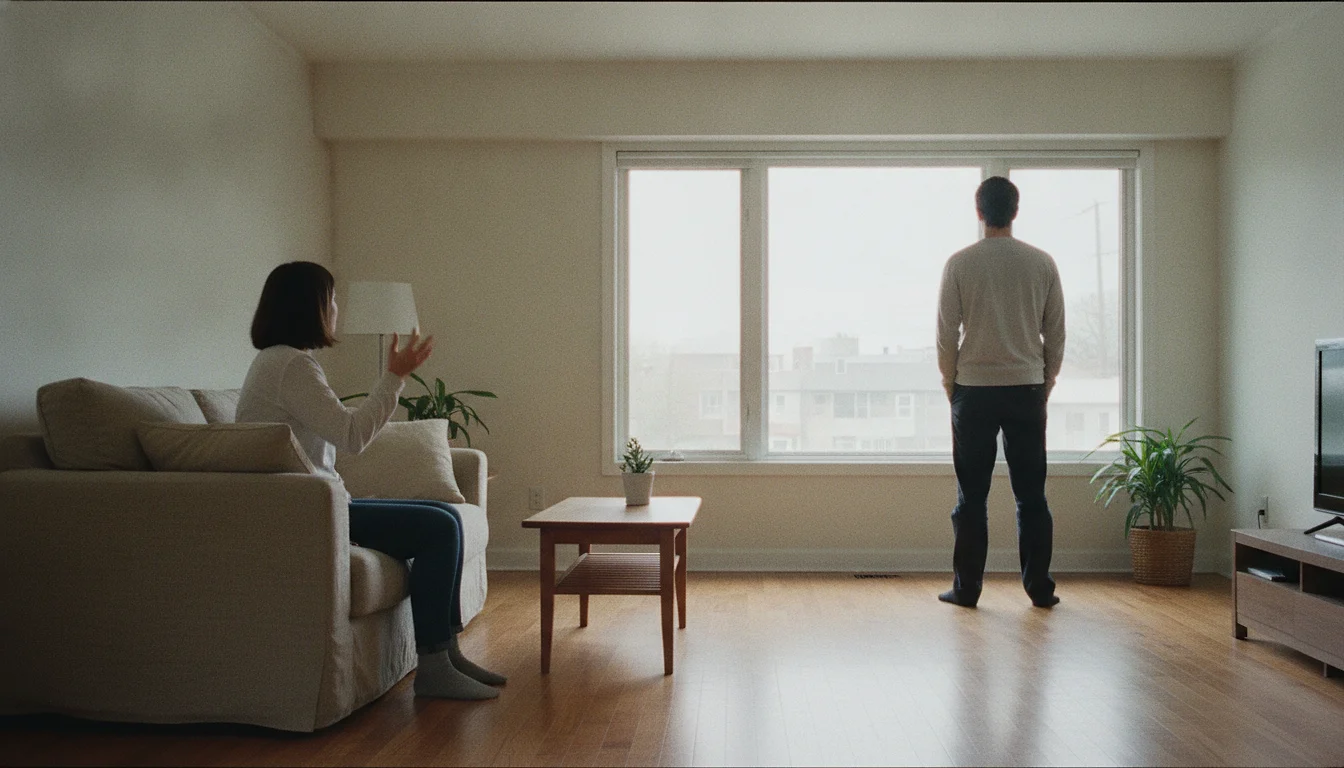
The emotional effects of stonewalling are cumulative rather than dramatic: loneliness and self-doubt for the partner shut out, guilt and dread for the one shutting down, and a shrinking list of subjects the couple can still discuss. They are easy to underestimate because nothing visible happens. For example, one partner asks a question, the other goes flat — one-word answers, eyes on the phone, or a walk out of the room — and the argument simply stops. No shouting, no slammed door worth reporting. But people who live with the pattern describe it as one of the loneliest experiences a relationship can produce, and the person doing the shutting down gets no winner’s share of it either.
This page describes what repeated stonewalling tends to do to the partner being shut out, to the person shutting down, and to the relationship between them. It stays at the level of lived experience, not diagnosis: stonewalling is a conversation pattern with recognisable consequences, and describing those consequences is different from telling you what is clinically wrong with anyone.
One framing note before the list. In John and Julie Gottman’s research on couples in conflict — the published material listed on our sources page — stonewalling is the fourth horseman, the late-arriving one, built on top of criticism, contempt, and defensiveness that have already worn a couple down. That matters for reading this page: the effects below are not the work of silence alone. They are what silence does when it becomes the standing answer to everything difficult.
What does stonewalling do to the partner being shut out?
Being shut out repeatedly tends to produce a recognisable cluster: feeling invisible, escalating in ways you do not recognise in yourself, self-doubt, loneliness inside the relationship, and wariness about raising anything at all. People shut out by a partner tend to describe a similar cluster of feelings, whatever else differs about their relationships.
Feeling invisible. The defining experience is talking to someone who is present in the room and absent from the conversation. A raised complaint gets less response than a stranger would give. Over time this lands as something worse than disagreement: disagreement at least confirms you were heard. A wall confirms nothing, and people start to wonder whether their concerns — and then whether they themselves — register at all.
Escalation you do not recognise in yourself. Silence pulls on people. The natural response to being unheard is to get louder, repeat the point, follow the retreating partner into the next room. Many shut-out partners are alarmed by their own behaviour in these moments — the sharpness, the pursuit — because it does not match who they are in any other setting. The escalation then becomes evidence in the next argument, which is part of what makes the pattern so sticky.
Self-doubt. When a partner will not engage, the argument never gets tested against another point of view. Shut-out partners rehearse conversations in their heads long after the argument, replay what they said, and ask whether the topic was ever worth raising. “Am I overreacting?” is the question that brings many of them to a search bar. The pattern gives them no way to answer it, because answering would require the very conversation that keeps being refused.
Loneliness inside the relationship. This is the effect people find hardest to explain to friends. The relationship looks intact from outside — meals happen, logistics run — while the person inside it feels they have no one to bring anything to. Being alone while partnered tends to hurt more than being alone, because the proof of the distance is sitting across the table.
Wariness around raising anything. After enough shutdowns, the shut-out partner starts scanning: is this the right moment, the right tone, the right day? Topics get weighed for their shutdown risk before being spoken. This is the point where the stonewaller’s pattern becomes the couple’s pattern — the wall no longer has to go up, because nothing likely to raise it gets said.
What does stonewalling do to the person shutting down?
The person behind the wall does not get the better half of it: they are flooded in the moment, chronically misread afterwards, guilty once it passes, and a little less able to stay in a difficult conversation each time. The stonewaller’s side is the less-told half of this story, and skipping it makes the pattern impossible to understand — because the inside of a shutdown looks nothing like the outside.
Flooding is the state Gottman’s team found underneath — the arousal measured in Levenson and Gottman’s work on the physiology of conflict: a body so far into stress response that taking in new information and forming replies stops being possible. Stonewallers describe a racing heart, a blank mind, and their partner’s words arriving as volume rather than content. The shutdown, from inside, feels less like a tactic and more like the only remaining move — closer to bracing than to punishing.
Around that core experience, a few effects accumulate. Being chronically misread comes first: in practice the flat face reads as indifference and the exit reads as contempt, when what is happening inside is closer to alarm. Being repeatedly accused of not caring — while overwhelmed precisely because the argument matters — builds its own quiet resentment.
Guilt after the fact is the second. Stonewallers tend to know the silence hurts their partner. Many replay the argument later with everything they could not say at the time and feel worse for it. The guilt changes little, because it arrives after the moment it could have changed anything.
A shrinking tolerance for conflict is the third and least visible. Every shutdown teaches the body that escape works: the flooding stopped when the conversation did. So the wall goes up earlier each time, on smaller topics, until the person is leaving conversations they might once have finished. What began as overload hardens into a reflex — which is why the partner who wants to change it has to work at catching the shutdown early rather than promising to try harder mid-argument.
What it does to the relationship itself
The effects above belong to two people separately. The third set belongs to the space between them, and it compounds.
Every stonewalled conversation is an unfinished one. The complaint that triggered the shutdown does not get resolved; it gets stored. The next attempt starts with the old charge still on the books, which makes it hotter, which makes the shutdown likelier, which stores it again. Couples in this loop often report that they no longer argue about anything current — every fight is the same fight, resumed.
Then the topics start disappearing. Consider money: it raised a wall, then raised it again, so money stops being raised. In-laws, intimacy, the future: one by one, subjects move onto the do-not-touch list, with no announcement from either partner. Conversation narrows to logistics — schedules, groceries, the children’s week — because logistics are safe.
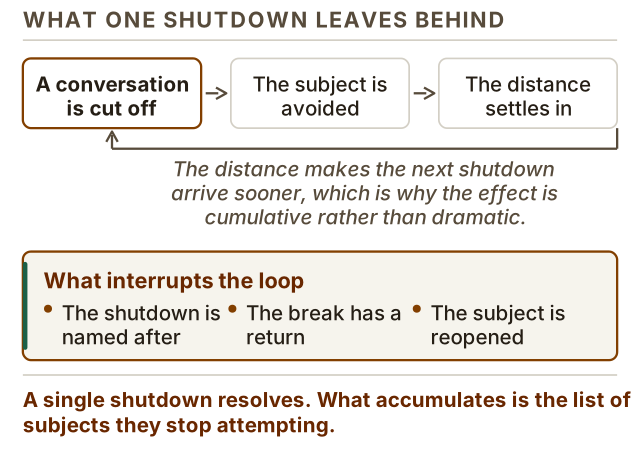
The end state is a couple that never fights and never talks — a household that runs smoothly and holds nothing. People arriving at that stage often say the silence stopped feeling like an event and started feeling like the climate. That is also the stage at which some shut-out partners begin asking a harder question about what the silence is for; the honest way to think about that question lives at when stonewalling is overwhelm — and when it is something else, not in a list of effects.
Everything above describes what the pattern tends to do, not what it has done to a particular pair of people. A reader is the only person who knows which of these effects is present in their own house, and a page cannot weigh them from a distance or say what follows from them.
Is stonewalling always the end of a relationship?
Not by itself. The honest answer has a shape worth stating carefully, because both halves of it matter.
Stonewalling earned its place among the four horsemen for a reason. In the Gottman studies of couples in conflict — among them Gottman and Levenson’s 1992 study of marital dissolution — its regular presence was characteristic of relationships that later ended. Treating it as harmless — a personality quirk, “he just needs space” — misreads a pattern with a documented trajectory.
But a horseman is a pattern, not a verdict, and the same body of work is explicit that the pattern is answerable. What the research pairs with stonewalling is not more talking but structured recovery: noticing the flooding, calling a genuine break, calming down away from the argument, and — the part that does the repairing — actually coming back. Couples who learn that sequence report the wall going up later, and coming down sooner, until conversations start finishing again.
The variable that separates couples who recover from couples who calcify seems to be joint ownership. As long as the shutdown is one person’s crime — his coldness, her nagging — each partner works on the other and nothing moves. When both can say “we do this thing where pressure goes up and the wall comes down,” the pattern becomes something the couple faces rather than something they trade blame for. That reframe is undramatic, and it is the hinge.
What no page can honestly tell you is which kind of couple you are. A pattern described in general terms cannot see the intent, history, or effort inside one specific relationship.
How do you cope with being stonewalled?
In the moment, stop pushing, make your point once, and propose a pause with a named time to return. Between arguments, keep a life that does not wait on the wall, and track the pattern rather than each incident. A structured break is a pause with an agreed time to come back — and a return that actually happens. Recovery is a couple’s project, but the reader of this page is often one person, mid-pattern, looking for what to do before any joint project exists.
In the moment, the counterintuitive move is the useful one: stop pushing. Pressure is the fuel the shutdown runs on, and every repetition of the point deepens the flooding on the other side. Make your point without repeating it, propose a pause with a named time to return, and hold the return. The full version of that practice — what to say, what reliably backfires, and how stonewalling differs from the silent treatment — is at how to respond to stonewalling.
Between arguments, two things protect the shut-out partner. The first is keeping a life that does not wait on the wall: friendships, work, anything that answers when spoken to. This is not a tactic to provoke a response; it is what keeps invisibility in one conversation from becoming invisibility as a self-image. The second is tracking the pattern rather than the incidents — which topics raise the wall, what precedes it, whether returns ever happen. A pattern can be brought to a calmer conversation, or to a counsellor, in a way a pile of grievances cannot.
And if the silence in your relationship does not look like overwhelm — if it arrives calm, selective, and priced — that difference matters more than anything in this article, and it is treated on its own page rather than in passing here.
What this page does not do
- Diagnose you or your partner
- Feeling anxious, lonely, or worn down by stonewalling is a description of an experience, not a clinical finding. If those states persist beyond the arguments, that is a conversation for a professional, and our sources page lists where to start looking.
- Put numbers on the damage
- Figures about stonewalling and divorce circulate widely, reworded beyond recognition. We describe what the Gottman research observed qualitatively and link primary sources instead of repeating second-hand statistics.
- Rule on your relationship
- A page that has never met either of you cannot say whether your relationship will recover. It can only describe what recovery has required for couples in the research: both partners seeing the pattern, and structured breaks that end.
- Assign a villain
- The shut-out partner is not oversensitive and the stonewaller is not heartless. Treating either as the problem is the framing under which this pattern gets worse.
What we read to write this page, and how we read it, is documented on our sources page.